Showing posts with label Chardonnay. Show all posts

Thursday, December 18, 2014

Time for Bubbly!
Part One - France

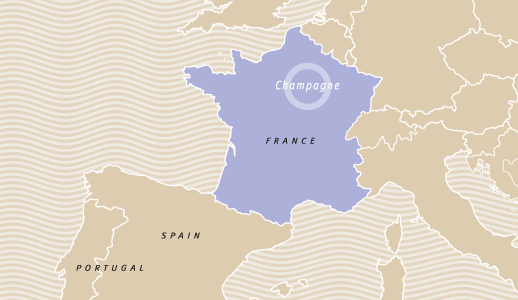
Once again the holidays are approaching and everybody is turning his attention to sparkling wine to ring in the New Year. Many people come in the store looking for “Champagne” but when I tell them a drinkable Champagne starts at $25.00 or so on sale, they realize that what they are looking for is sparkling wine. Champagne is sparkling wine made in the Champagne region of France. The grapes must be from that region and secondary fermentation must occur in the bottle (Methode Champenois or Traditionelle). The wine is fermented and bottled. Yeast is then added, and the secondary fermentation results in bubbles which are trapped in the bottle. Champagnes tend to be pricy, starting in the upper twenty dollar range, with most being in the $40-80s and some reaching several hundred dollars. Champagne is made from three grape varietals—Chardonnay, Pinot Noir, and Pinot Meunier.

Sparkling wines are made in many other parts of France and the world, and many are extraordinary. I will talk about those made in France today, and in the next article I’ll explore those from other countries. All the wines discussed here are made in the same way as those in Champagne, although they may be made from different grapes. More importantly, they are significantly less expensive.

Sparkling wines from the tiny town of Limoux, in Southwestern France offer great value. This is actually the birthplace of sparkling wines. The monks in the Abbey of St Hilaire discovered secondary fermentation and put it to use in 1536. A local varietal, Mauzac, is the primary grape used, along with small amounts of Chardonnay. These wines are fresh and dry with flavors of apple and pear and a beautiful acidity. Elegance Blanquette de Limoux is my every day sparkler and is a bargain at $12.99. Buy cases of this for your New Years Eve party!

The region of Burgundy is home to Cave Lugny Cremant de Bourgogne. (cremant basically means a sparkling wine made in France but not made in Champagne). This wine is made from Chardonnay and Pinot Noir and has a beautiful minerality and acidity, delicate perlage (tiny, delicate bubbles) and nuances of brioche and apple. This is an elegant, flavorful bubbly that costs only $16.99 and drinks like it is a lot more expensive.

Alsace is a region famous for its white wines – Pinot Gris, Pinot Blanc, Riesling, and Gewürztraminer. They make wonderful sparkling wine as well, and my favorite is Lucien Albrecht’s Cremant D’Alsace, a beautiful sparkler made from 100% Pinot Blanc. It has a very fine perlage and delicate nose and flavors of apple and pear. This is a delicious wine that rivals $40 Champagnes and has performed very well against them in private tastings that I have done. At $18.99, a single bottle simply will not suffice.

Our final stop before Champagne is another northerly region, the Loire Valley. This is the home of sparkling Vouvray. Wines from this appellation are made from 100% Chenin Blanc. The Francois Pinon Brut is a fantastic example. Sourced from organic vineyards, this wine is a perfect expression of terroir, orchard fruits, spices, and minerals. This would be $22.99 very well spent.

This leads us to the “Mother of all Sparkling Wine,” Champagne. Nothing suggests celebration more than a bottle of this sparkler. Of course, the most well known are those from the big houses that buy from up to hundreds of growers and then literally assemble the wines in the cellar from many lots, thus keeping their style consistent year after year. Well known examples are Moet Chandon Imperial Brut and Veuve Cliquote Yellow label Brut. Priced in the $39-45 range during the holidays, these are beautiful, minerally wines with hints of apples and pear, creamy delicate perlage, and bracing acidity. One of my very favorites in this group is Billecart – Salmon Reserve Brut. At $52.99, this is one of the very best non vintage champagnes one can find done in a traditional house style. Rosé versions of most of these Champagnes can be found but are in limited quantities and are more expensive. Billecart makes probably the best non
vintage rosé Champagne I’ve ever had but will set you back $86.99 for the experience.

There are two versions of Champagnes that are becoming better known and are well worth searching out. First is the so called Brut Nature or Extra Brut. After fermentation, a small plug of yeast and debris is removed from the bottle. The resulting space is filled with a tiny amount of still wine and sugar. If the amount of sugar is small, the result is Brut (every wine discussed so far has been Brut). A little more sugar results in Extra Dry and a little more results in Demi Sec. With Brut Nature or Extra Brut, essentially no sugar is added and these are bone dry, steely, minerally wines that are truly beautiful. Francis Boulard Les Murgiers Brut Nature, a blend of Pinot Noir and Pinot Meunier, is my favorite at a cost of $49.99.

Grower Champagnes are the wines I feel that anyone who wants to experience the true “Champagne Experience” needs to search out. These estates have their own vineyards and bottle their wines after each harvest. They often save lots from previous vintages to blend in with the current vintage to make the wine more consistent year after year, but they still demonstrate incredible character approaching that of vintage Champagnes. Champagne Piollot, a blend of 80% Pinot Noir and 20% Chardonnay, is loaded with minerals, orchard fruit, and notes of fresh baked bread, the latter being a characteristic usually only seen in vintage Champagnes. At $37.49, this is probably the best value on the entire sparkling wine aisle. Champagne Aubry is another excellent example at $48.99.

Finally, at the top of the heap, are the Vintage Champagnes. These wines are made only in years when conditions allow for the best quality grapes and only grapes from that vintage are used and the bottle is labeled with the year of the harvest. These are the very best Champagnes that are meant to age into otherworldy wines. Perhaps the most well known are Moet’s Dom Perignon and Veuve Clicquot’s La Grande Dame. These wines are excellent at release, but if you have the will power, put one in your cellar for ten years and you’ll find out what all the fuss is about. Upon opening, the nose of yeasty brioche makes you feel like you are standing in a bakery. This is followed by complex aromas and flavors of apple, honey and minerals, and baking spices. These wines are magnificent. You might actually forget you paid $130-$200 for the experience.

You can celebrate with style no matter what your budget, so get in on the act and enjoy! Happy holidays!

Monday, October 27, 2014

Donald Hess—Entrepreneur and Visionary

Donald Hess, a Swiss entrepreneur, bought 900 acres on Mount Veeder (situated between Napa and Sonoma Valleys) between 1978 and 1982, setting aside 600 acres to support wildlife corridors and biodiversity. Immediately, sustainable practices, as defined by the Wine Institute, were utilized in the vineyards. The old stone winery, originally built in 1903, was opened to the public in 1989. Since that time, the Hess Collection of wines has become synonymous with quality wines and green farming.

I had the opportunity to visit Hess a few weeks ago, and it was a memorable experience. Within a few hours of landing in San Francisco, my new friends and I were sitting at a picnic table in the middle of the Allomi Vineyard looking out over 210 acres of vines. The vineyard, purchased in 1997, sits at the base of Howell Mountain in the beautiful and remote Pope Valley. Although Sauvignon Blanc, Petite Sirah, and Petite Verdot are also grown here, this vineyard is best known as the source for the Hess Collection Cabernet Sauvignon Allomi. Mike, our host, poured the 2012 as we enjoyed an incredible picnic lunch prepared by Hess’s chef. This wine is a quintessential valley floor Cab with luscious red fruits that are joined by a bit of blackberry and black currant. The tannins are ample enough to lend support and complexity but are well integrated for a soft, round mouth feel. Selling for $28.99, this is a delicious wine! The six of us polished off two bottles before leaving this beautiful place and resuming our adventure.

We then headed up Mount Veeder, almost to the very top, to the Veeder Summit vineyard. Hess is so dedicated to sustainable green farming that dozens of goats are released before bud break each spring to clear undergrowth around the vines so there is less dependence on vehicles. There are fully a dozen varietals grown here, with the early ripening Malbec and Merlot being the most dominant. Looking southwest, we could see as far as the towers of the Golden Gate Bridge and 115 acres of vines spread out before us.

We gazed out over the magnificent vista as we drank a bottle or two of Hess 19 Block Cuvee. A blend of Merlot, Cabernet, Syrah, and Malbec sourced mainly from the vineyard we were sitting in, this wine has beautiful red berry fruit, clove, and cinnamon on the nose followed by a mouthful of red fruit. A soft tannic finish laced with raspberry and a hint of vanilla make this a wonderful wine. It sells for $31.99 and is worth every penny.

We then went to the beautiful old stone winery, where we tasted several wines in the garden. We tasted a few winery-only wines that were very good, especially an awesome Petite Sirah. We also tasted through the Hess Select series. These entry level wines are sourced from all over California and are very well made for the price they sell for. There is a Monterey Chardonnay, fresh and vibrant without being overwhelmed with oak, and a very correctly made citrusy Sauvignon Blanc, both of which sell for $10.49. The Pinot Noir was a pleasant surprise, with cola, cherry fruit, and spice. The Treo, a blend of Syrah, Petite Sirah, and Merlot, full of cranberry, pomegranate, black cherry, and spice, is jammy and easy drinking, a perfect BBQ wine. Both these wines sell for $12.49 and are great values.

The tasting completed, we now walked up to the library, gazing at Mr. Hess’s amazing art collection on the way. We enjoyed a wonderful meal and, of course, wonderful wines to match each course. The most noteworthy wine was the 2012 Napa Valley Chardonnay, served with a pan seared halibut. This delicious Chardonnay, is sourced from the Su’skol Vineyard on the Napa Valley floor, barely ten miles from San Francisco Bay. Morning fog from the bay cools the hot Napa Valley microclimate, providing perfect growing conditions for Chardonnay, and it shows in the wine. I tend to be an ABC kind of guy (anything but Chardonnay) but this wine is remarkable. The musque’ clones used in the vineyard result in beautiful floral aromatics and flavors of honeysuckle and apple with a background of citrus and tropical fruits. Acidity is perfectly balanced against a rich mouth feel. Only 25% malolactic fermentation and aging in neutral oak result in a perfectly balanced, vibrant Chardonnay. This wine is a must for Chardonnay fans at $21.99.

The next day we visited the 175 acre Su’skol vineyard, and Kate, the winemaker gave us a tour of the massive 850,000 case facility that Hess has nearby. From there we continued our adventure in wine country, but we are not soon to forget our experience at Hess. If you go to Napa Valley make sure to visit the winery. But in the meantime, enjoy the wonderful wines that come from this venerable estate, whether they are from the excellent value Hess Select series or the amazing estate wines. You will be impressed.

Cheers!

Tuesday, February 19, 2013

The Aromatic Whites—Taste the Grape, Not the Oak


Far too many people limit their experience of white wine to oaky Chardonnay and the occasional Sauvignon Blanc or Pinot Grigio. If they find these wines a bit boring, they tend to consider consider themselves “red drinkers.” If I’ve just described you and you’re sick of buttered oak, try the the aromatic family of wines. These wines earn their name by their beautiful, intense aromas—not from oak, as most are completely unoaked, but from their respective grape.

When I’m walking down the street trying to decide which restaurant to try, I look at the wine glasses on the table. If they are small with narrow mouths, I keep walking. That is because aromatics play a very important role in the wine experience. The senses of taste and smell are closely integrated. If you have a stuffy nose, your ability to taste is dramatically decreased. If your wine is in a tiny glass with a narrow opening it doesn’t taste near as good as the same amount of wine in a large glass with a wide bowl. Aromatic wines not only have intense fragrances, but intense flavors as well.

The flavor profiles of these wines express the flavor of the grape and even the subtle differences in terroir and winemaking because they are not masked by oak and butter. The most important trait these wines share is that they are wonderful with food. They tend to be lighter bodied, lower in alcohol, and higher in acidity—all characteristics of great food wines. Although delicious on their own, they are the darlings of restaurant sommeliers because they go so well with food—even the hard to match spicy dishes.

So what are the “aromatic white wines”?

Muscat: Perhaps the most aromatic of all, with fresh flowers and stone fruit leaping from the glass. This is the grape of Muscato d’Asti from Italy done in the frizzante (lightly sparkling) style. Try the Vietti Cascinetta ($16.99). Still wines from this grape are made in Alsace.

Gewurztraminer: With characteristic aromas and flavors of roses, lychee fruit, and spice, the best examples come from Alsace. This wine is more medium bodied and has a robust flavor that makes it a great Thanksgiving wine. Try Joseph Cattin ($17.99) and the Gold Medal by the same maker for $2 more.

Viognier: This grape comes from the upper Rhone Valley, but Australia and California also produce it. Very floral on the nose with flavors of peach and apricot and probably the most full bodied of the group, this is the only one that is sometimes oaked. Chardonnay fans should start with this one. Yalumba Eden Valley ($22.99) is big bodied example from Australia.

Riesling: The “noblest” of the aromatic grapes, the best examples of this wine come from cool climates—Germany, Austria, Alsace, and Washington State. These wines can be bone dry to very sweet. Aromas and flavors range from citrus to stone fruit to tropical fruit. The hallmark of this varietal is low alcohol, high acidity, and a striking minerality (aroma and taste of stones, limestone, or slate). These traits make Riesling an incredible wine for food matching. Kung Fu Girl ($11.99) is a nice example from Washington State that is off dry.

Torrontes: This is Argentina’s signature white grape. There are intense floral and spice aromas and flavors with a low acidity. This wine is one of my favorites with Mexican food. Try Alamos ($9.99).

Albarino This grape is from Spain and Portugal. It has a high acidity with beautiful peach, citrus, flowers, and minerality on the nose and palate. Burgans ($14.99) is a nice example.

Moschofilero: This Greek varietal produces a wine similar to Muscat, except it is drier and lighter bodied with orange-tangerine-citrus notes. A nice one is made by Boutari for $14.99.

Everything white is not Chardonnay. Next time your meal or occasion calls for a white wine, look to these amazing varietals. Even the “only red” drinker will take notice.

Cheers!

Sunday, October 14, 2012

Grower Champagnes – A New Approach to “Bubbly”


As the holidays approach, sparkling wines come to mind, from inexpensive Proseccos from Italy and Cavas from Spain, to the myriad California and French bubbly to the most famous (and expensive) of all—Champagne (sparkling wine from the Champagne region of  France). Nothing seems to epitomize celebration like Champagne, and when most people consider buying it they look for the large houses such as Moet et Chandon or Veuve Cliquot. These producers source their grapes from all over the region and blend various lots from different areas and even different years to maintain a consistent flavor and style year after year.

There is, however, an interesting alternative—the grower champagnes. The  vineyards sourced by  this type of maker are clustered in a single village and sometimes even a single vineyard. The wines are crafted to reflect the terroir of the village, especially if it is a grand cru vineyard.

Grower Champagnes are usually released younger and often show a lower dosage (the process of adding sugar before final corking) and occasionally no dosage at all. Before shipping, most producers disgorge the deposits that collect in the bottles. The resulting space is filled with a shipping liquor and a tiny bit of pure cane sugar. The absence of dosage allows the intrinsic qualities of the wine, such as terroir and minerality, to show through.

The downside is these wines are more variable year to year compared to the large houses. But the wines are far more interesting and flavorful. Today there are 19,000 growers in Champagne and about 5000 are making their own wines as the popularity grows. To find out if a Champagne is a grower Champagne look for the initials RM (recoltant-manipulant) or ask your wine associate.

While the number of wines is staggering, here are few examples that you can’t go wrong with. Champagne Moutard  is one of my favorite Champagnes period. It is from a grand cuvee vineyard and is 100% Pinot Noir. The wine bursts with brioche, pear, and peach aromas and flavors with beautiful notes of honey, flowers and minerals. The price is about $43.00—not cheap, but on par with Veuve or Moet Chandon NVs, and far more interesting.

Champagne Aubrey is made from a majority of Pinot Meunier with Pinot Noir and Chardonnay as part of the mix. All the fruit is from Grand Cru vineyards. Fresh apples leap from the glass to your nose, with hints of cocoa and toast. There are flavors of passion fruit, apricots and spices, even mango. This wine undergoes malolactic fermentation, giving it impressive body. A beautiful Champagne for $45.00.

Finally there is Jacques Copinet, a NV Champagne that  mimics an aged Vintage Champagne. The aroma is of buttered toast sprinkled with a bit of molasses. On the palate there is a wonderful balance of power, intense caramel breadiness, and wonderful elegance.  Worth the $50.00 you’ll have to spend.

When it’s time to celebrate, try one of these Champagnes and have a truly wonderful experience.