Showing posts with label French Wines. Show all posts

Monday, April 15, 2013

The Southern Rhone—Grenache is the King, but Others Help


We now head south past the city of Montelimar into the Southern Rhone. This region is more spread out than the Northern Rhone, with many small towns nestled in the hills on both sides of the river.  Many of these towns are tiny and beautifully picturesque, with narrow cobblestone streets and quaint names like Segurat and Sablet.

The climate here is more Mediterranean, and the differing terroir combines with the rugged terrain partially protecting the valleys from the mistral to produce varying microclimates. As a result, a diversity of wines are produced. Grenache is the most widely grown grape here. Also found are Syrah, Mourvedre, Cinsault, and Carignan, among others. In fact, the most famous A.O.C. here, Chateauneuf du Pape, allows up to ten different varietals in the red wines and nine in the whites. Gigondas, on the other hand, another well known appellation, only allows Grenache and a few others. The white varietals are primarily Ugni Blanc, Roussanne, Bourboulenc, Picpoul, Viognire and Clairette.

Most of the red wines are pleasant, fruit-driven (primarily dark fruit) earthy wines. Those from Chateauneuf du Pape have power and structure and can rank with Bordeaux and Burgundy as the country’s most respected wines. They are all excellent food wines, are great with pork, game, poultry, sausage, and are as good as it gets with lamb. They are also priced much lower than the Northern Rhones, with very good examples in the $12.00 to $20.00 range. Only the great Chateauneuf du Papes are really expensive.

While the majority of the wines are red, some very nice whites are produced here as well. They are usually blends with a combination of fruit, acidity, and minerality that make them interesting and food friendly. The A.O.C. of Tavel is one of the world’s most famous areas of rosé production. Finally, the appellation of Muscat de Beaumes de Venise produces fortified white wines.

Labels indicate the quality of the wine according to the following classification:

Cotes du Rhone—denotes wines from the entire southern Rhone.

Cotes du Rhone Villages—higher minimum requirements for wine maturation and production.

Cotes du Rhone + village name—Usually the highest standards before Cru status.

Cru—the name of the actual A.O.C. is on the label, best quality of all. These are wonderful wines for the price. They are Chateauneuf du Pape, Gigondas, Lirac, Rasteau, Muscat de Beaumes de Venise, Tavel, and Vacqueyras.

The shelves in our store contain dozens of these great wines, but here are a few of my favorites.

Cotes du Rhone: Chave’s Mon Coeur 2010 (Grenache, Syrah) shows kirsch and black currant fruit intermixed with earth and spice. Luscious but has good structure. All this for $19.99. Chapoutier’s Belleruche 2010 (80% Grenache, 20% Syrah), an excellent bargain at $12.99, has wonderful red fruit aromas with dark red fruit and spice flavors. There is surprising structure at this price. At the same price point, Oraison 2009 shows the lush fruit typical of that vintage.

Cotes du Rhone Villages: Domaine Boisson Cairanne 2010 (Grenache, Syrah, Mourvedre, Carignan). Prepare yourself for awesome red and dark fruit, great earthy structure. I love this wine at $19.99, and the L’Exigence 2009, its big brother, is ready to knock your socks off after getting an extra year in the bottle.

Cru: Cuvee Prestige Gigondas 2011 (Grenache, Syrah, Mourvedre) is an amazing bargain at  $19.99. The  typical price from this appellation is $30.00-40.00, but this is classic Gigondas with a fleshy and velvety mouth feel. There are lush blackberries, plums, cherries, licorice and spice on the palate, held together by soft but structured tannins with a long spicy finish. This is a lot of wine for $19.99.

My vote for best Chateauneuf du Pape for the money is Bois de Boursan 2009. Classic, old school, full throttle Chateauneuf with rich layers of fresh and stewed fruit, wet earth, spice, juicy tannin… OMG this is good! It’s not cheap at $47.99, but great Chateauneuf is never cheap. Get this for that special occasion or meal. You will not soon forget it.

The Rhone Valley is definitely a wine region to be explored. There are great bargains from the south and great wines from both sub regions, so do yourself a big favor and check them out.

Tuesday, April 9, 2013

The Northern Rhone Valley—Where Syrah is King


The Rhone region of southern France produces marvelous wines and is one of the most beautiful yet least visited areas of that country. The region is divided into two sub regionsthe Northern Rhone and the Southern Rhone. The wines from the two regions are different in composition and in style (and as a rule, in price.)

Grapes have been grown in this area since about 600 B.C.E. Various theories give credit to the Greeks, Persians, and Romans for initiating viniculture here, but all agree that genetic studies prove the Syrah grape indeed originated in the Rhone.

The Northern Rhone, where the vineyards are often on incredibly steep hillsides overlooking the river, has a continental climate influenced by mistral winds which bring in cool air. Winters are harsh and summers are warm. Syrah is the only red grape allowed in A.O.C. wines here. For Cornas A.O.C. designation, the wine must be one hundred percent Syrah. The other appellations allow addition of white varietals such as Viognier, Roussanne, and Marsanne, although only Cote Rotie widely does this. Some white wines are produced. Viognier is produced in the northernmost part, and blends are made from Marsanne and Roussanne in some other areas.

The Syrahs from this region are earthy, meaty, and structured on a tannic backbone. They are very different from the much more fruit-forward versions from California and Australia (where the grape is known as Shiraz.) Aromatics of smoky bacon and green olives are classic. Northern Rhone and lamb are a match made in heaven.

The appellations are as follows, as you drive north to south:

Cote RotieSyrah with up to twenty percent Viognier. Wines are elegant and layered. They tend to be very expensive and are produced in small amounts. Guigal’s single vineyard Cote Roties cost almost $300.00 per bottle at release

CondrieuProduces white wines only of Viognier. The varietal reaches its greatest heights—incredibly aromatic and floralin this regionThe climate in Condrieu is difficult. Fierce cold winds during winter sometimes cause havoc during budding and flowering. The clone of Viognier grown in Condrieu produces lower yields and smaller berries than other clones grown in France or elsewhere. As a result, Condrieus are very pricey and are difficult to find under $50.00.

Chateau GrilletThis appellation consists of only one estate (called a monopole) comprising a little over three hectares and producing whites from Viognier. The Viognier from this estate is unusual in that it is meant to age up to ten years before reaching its full maturity. The wine is hard to find and expensive, but is a rare experience.

St JosephRed wines of Syrah and up to ten percent Marsanne and Rossanne. These wines are earthy, structured, and a beautiful expression of the Syrah grape. They are also a relatively good value for the Northern Rhone. Offerus, from Chave, one of the Rhone’s great producers, is a wonderful wine for $29.99. It shows meaty black cherry and black currant notes intermixed with damp earth and forest floor. It is an excellent introduction to the northern Rhone.

Croze-HermitageRed wines of Syrah with up to fifteen percent Marsanne and Roussanne. This is the other appellation to shop for in looking for affordable northern Rhone wines. Chave also has a great offering here at 27.99. The wine is stuffed with dark raspberry, plum, and licorice, with graphite and smoke on the finish. Jean-Luc Colombo does a nice one too. Finally, Chapoutier, another of the Rhone’s great sources, makes a nice white Croze-Hermitage, Meysonniers, that is delicious.

HermitageRed wines of Syrah and up to fifteen percent Roussanne and Marsanne. According to legend, a knight named Gaspard de Sterimberg returned wounded from the Crusades. The Queen of France permitted him to build a small refuge on a hilltop in which to recover, and he lived there as a hermit. The hill is now owned by one of the great negociants of the region, Paul Jaboulet Aine. These wines were favored by royalty, and in the nineteenth century, some Bordeaux wines were “hermitaged” by blending in wine from this appellation to fetch higher prices. These are huge, powerful, age-worthy wines that are very expensive. They have aromas and flavors of leather, red berries, earth, and coffee. Many are over $100.00 at release.

CornasRed wines from one hundred percent Syrah. This is one of the smallest appellations. It is on lower hillsides and is partially protected from the mistral winds, hence its climate is a bit warmer. The fruit ripens well and harvest tends to occur the earliest of the northern appellations These are dark, inky, very powerful renditions of the Syrah grape. Domaine Courbis Cornas Champlerose is insanely good at $47.99. Robert Parker, giving this wine 94+ points, says, “This wine shows terrific full-bodied texture with gorgeous ripeness, purity, and expansiveness.” It will drink beautifully for decades.

The wines from the Northern Rhone are very special. Viognier and Syrah reach heights here to which all other examples of these varietals are compared. To try them is to truly experience what these two grapes are meant to be.

Wednesday, April 3, 2013

Pinot Noir
The World’s Most Difficult Grape—But Worth It!


Pinot Noir is one of the oldest grape varietals in the world. Originating in Burgundy, France, where it is the source of some of the world’s best wines, the grape is now grown in California and Oregon in the U.S., as well as in Chile and New Zealand.

Difficulties with Pinot Noir occur at virtually every step of wine production. It is genetically unstable, and the parent vine can produce offspring that bear fruit totally different in size, aromatics, and even flavor. This has resulted in hundreds of inferior clones that need to be sorted from the good ones. Any affliction that can affect vines occurs commonly in Pinot Noir. Because it leaves early, it is susceptible to spring frost. It is a perfect host to the sharpshooter leafhopper, which causes Pierce’s disease and can wipe out a vineyard in three years. Leaf roll, a viral infection, is common. The vine is not very vigorous so there may be not enough leaf cover to protect the fruit from birds. This plus the fact that the grape is very thin skinned means berries can shrivel quickly and dry out if picked too late.

Pinot Noir is even difficult to ferment. It ferments rapidly and violently, sometimes out of control. Color retention is a common problem because of the thin skins. Finally, a process known as acetification can occur, causing aromatics and flavors present during fermentation and aging to disappear when the wine is bottled.

Pinot Noir prefers cool climates and chalky, well-drained soils. If grown in warm weather, the delicate aromas and flavors don’t develop. Burgundy has just such a climate and terroir. Willamette Valley, Oregon is at the same latitude as Burgundy and has a similarly cool climate. Pinot Noir grows best in cooler regions of California such as Carneros and Russian River. Cool climates are the most varied, so different vintages vary greatly.

So why do vintners bother with such a difficult grape? Because it can make incredibly aromatic, flavorful wines with a perfume of strawberry, raspberry, black cherry, tea, mint, violets, and spices. The flavors (similar to the aromatics) are delicate but can be quite intense. Pinot Noir tends to be a medium bodied wine with soft tannins and a balancing acidity. Done right, it can be like liquid silk—a profound experience. Aging in oak enhances these characteristics beautifully. It is a wonderful food wine, matching well with Salmon, fowl, ham, and lamb.

There are differences among Pinot Noir from Burgundy, California, and Oregon. Burgundies tend to be lower in alcohol, more structured, and less fruit juicy than American wines. They have more earthy and herbal notes and tend to age longer. Many critics feel Burgundy is a better food wine—it accepts food without overwhelming it, and its lower alcohol and slightly higher acidity balances and brings out the nuances in the accompanying dishes. California Pinot Noir tends to be softer, more lush, and more fruit forward, has a higher alcohol and usually less structure. It is a better wine for drinking on its own.

Oregon seems to be somewhere in the middle of the two. The climate is more similar to Burgundy, but the soil is richer and more volcanic. Oregon Pinots differ greatly among themselves, but tend to be more earthy than California Pinots with a complexity sometimes rivaling Burgundy. The fruit forwardness, however, more closely mimics California.

Another difference among the wine from Burgundy, California, and Oregon is the price. Burgundy is the most expensive, with almost nothing drinkable below $20.00 and prices from the best growers starting at $100.00. Domain de la Romanee Conti wines are over $1000.00 per bottle at release, are the most expensive wines in the world, and are sold out every year. However, some Burgundies are quite affordable, like Seguin Gevrey Chambertin at $47.99 and Regis Bouvier Bourgogne en Montre Cul at $29.99.

California does some really nice Pinot Noir in the $15.00 to $25.00 range, such as Wyatt, Au Bon Climate, Block Nineteen, and Banshee. There are some pricier ones that are really awesome. Try Melville Estate for $27.99.

Oregon is making a lot of really great Pinot Noirs, and this grape has become the state’s signature red grape. Holloran makes two wines. The entry level offering, at $22.99, is called Stafford Hill and is my choice for the best Pinot Noir in the store at this price point. The upper level one is only $7.00 more and is a beautiful mix of perfume, flowers, fruit, and earth. There is a small producer called Tyee whose barrel select Pinot is wonderful at $28.99.

New Zealand is becoming as well known as much for its earthy, funky Pinot Noirs as it is for its Marlboro Sauvignon Blancs. Sherwood and Allan Scott are good values at under $20.00 and are fairly typical of Pinots from this country.

Finally, some definite bargains are coming out of Chile, which is known best for its Carmenere and Cabernet. Llai Llai is a nice example for $10.00 and Cantaluna and Root One are in the same price range. These wines are good places to start if your wallet is a bit light because they are true Pinot Noir. Be careful of inexpensive California Pinot Noirs. Syrah is often added generously to the blend (in California to be called a specific varietal the wine must contain only 75% of that grape) so you may get a pleasant, quaffable wine, but it tastes nothing like Pinot Noir.

Pinot Noir can be amazing and can be a great wine with dinner or by the glass on your patio. As tricky as it is to grow and make into wine, it can also be tricky to shop for. So ask your wine geek for the best….it will be an awesome experience.

Tuesday, March 5, 2013

Red Bordeaux—Expensive and Confusing?
Nope… Hints to “Bank” On


Customers are afraid of the Bordeaux section because first, they figure it will be expensive, and second, they don’t understand what they are reading on the label. Have no fear. Simply put, a red Bordeaux wine is a wine produced in the Bordeaux region of France. It is the largest French wine producing area, composed of over 120,000 hectares of vineyards and producing over 700 million bottles of wine each year.

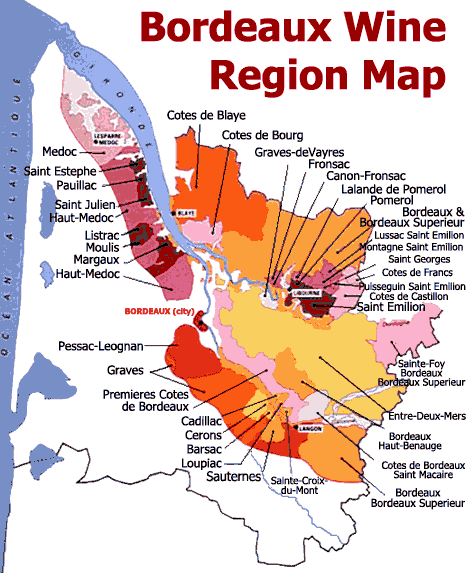
The region’s hub is the city of Bordeaux, which sits on the west bank of the Gironde River and runs from southeast to northwest on its course to the Atlantic Ocean in west central France. Just north of Bordeaux, the Dordogne River empties into the Gironde from the southeast, forming a “Y”. The Estates along the western bank of the Gironde are known as “Left Bank” and those along the east bank of the Dordogne are known as “Right Bank.” The area between the two arms of the “Y” is known as “Entre Deux Mers” (“between two seas.”)

Why do we care about all this? Here's why:

By law, only six grapes that can be included in red wines from Bordeaux—Cabernet Sauvignon, Merlot, Cabernet Franc, Malbec, Petit Verdot, and Carmenere. The first two are by far the largest contributors. The climate and the soils are vastly different on the Left and Right Banks—so much so that Cabernet Sauvignon grows far better on the Left Bank, and Merlot and Cabernet Franc far better on the Right Bank and in Entre Deux Mers. Consequently, Left Bank wines are Cabernet predominant and therefore more tannic, structured, and long lived as a rule (and less approachable at an early age.) The wines from the Right Bank are Merlot driven, with Cabernet Franc as an important component and much less Cabernet Sauvignon. Right Bank Bordeaux tends to have lusher fruit, somewhat softer tannins, and can be enjoyed at an earlier age. So when you come to the store, you’ll know which “Bank” of Bordeaux you prefer.

If only the label on the wine said “Left” or “Right” Bank, the world would be perfect, but that would be too easy. Instead, the label will usually indicate the appellation, and you should leave it up to your wine geek to know that Medoc, Haut Medoc, Margaux, St. Estephe, Graves, and St. Julian are all Left Bank, and Pomerol, St Emillion, and Canon-Fronsac are Right Bank. As long as you know what style you like, you will get a wine you love.

In 1855, Napolean III requested that Bordeaux wines be classified into five levels, or growths, according to the amount of money they commanded. Four first growths were named—Lafite Rothschild, Margaux, Haut Brion, and Latour. In 1973, Mouton Rothschild was added. All five of these wines are from the Left Bank and cost upwards of $1000.00 per bottle upon release. Even fifth growths which fifteen years ago could be purchased for $30.00-$45.00 now cost over $100.00. Although the Right Bank wines aren’t in this classification, Chateau Cheval Blanc, Chateau Petrus, and Chateau le Pin are still in these price ranges.

Because of these crazy prices, most of us will never get a chance to try these wines, which fuels the idea that Bordeaux is only for the rich. This is not true. Although the first through fifth growths are the most famous fifty or so wines from the Left Bank, and about twenty similar wines exist from the other side, over 8400 other Bordeaux producers remain. These “petits chateaux” produce very nice wines for $40.00, $25.00, and even $15.00. These wines express the terroir and varietal character of the appellation where they are grown and are pleasant to drink often upon the day of bottling. They don’t age like the classified growths but will improve over three or four years.

Bordeaux wines as a rule are made from rather tannic grapes and they are aged in oak, so they’re going to be tannic. Don’t look to these wines for sipping at a cocktail party or drinking on their own by the fire one evening. These are food wines. They have aromatics and flavors of red and black fruit, with solid structure and good acidity. They tend to be a bit lower in alcohol than their California counterparts. These characteristics are typical of the cooler climate in Bordeaux. Because the climate is cool, year to year variance can be marked. Time of last frost, daily temperatures, and amount and time of rainfall all have a huge influence on the quality of wine in a given year. Be sure to ask your wine specialist which vintages to avoid or look for, or which are best for drinking early or putting away for a few years.

So tonight you are having a dinner of beef, lamb, or game. Bordeaux is an excellent choice. If you want to splurge a bit and like the structure of Cab based wines, the Chateau Mongravey (Margaux) is outstanding for $44.99. The Right Bank and Merlot predominant L’Excellence des Menuts at $42.99 is drinking perfectly.

Want to spend less and still drink well? From the Left Bank we have the Chateau Le Pey (Medoc, $16.49) and Chateau Beauregard Lagupeau (Graves, $16.99), and from the Right we have La Croix Bonnelle (St. Emillion, $16.99) and La Croix Meunier (St. Emillion, $24.99). These are all nice examples of Bordeaux at reasonable prices. There are others in the $10.00-12.00 range that will amaze you.

Bordeaux doesn’t have to be complicated and it certainly doesn’t have to be expensive. Wines from this area have been among the most renowned in the world for hundreds of years. It’s time you found out what all the fuss is about. You will be glad you did.

You can “bank” on it!

Sunday, October 14, 2012

Grower Champagnes – A New Approach to “Bubbly”


As the holidays approach, sparkling wines come to mind, from inexpensive Proseccos from Italy and Cavas from Spain, to the myriad California and French bubbly to the most famous (and expensive) of all—Champagne (sparkling wine from the Champagne region of  France). Nothing seems to epitomize celebration like Champagne, and when most people consider buying it they look for the large houses such as Moet et Chandon or Veuve Cliquot. These producers source their grapes from all over the region and blend various lots from different areas and even different years to maintain a consistent flavor and style year after year.

There is, however, an interesting alternative—the grower champagnes. The  vineyards sourced by  this type of maker are clustered in a single village and sometimes even a single vineyard. The wines are crafted to reflect the terroir of the village, especially if it is a grand cru vineyard.

Grower Champagnes are usually released younger and often show a lower dosage (the process of adding sugar before final corking) and occasionally no dosage at all. Before shipping, most producers disgorge the deposits that collect in the bottles. The resulting space is filled with a shipping liquor and a tiny bit of pure cane sugar. The absence of dosage allows the intrinsic qualities of the wine, such as terroir and minerality, to show through.

The downside is these wines are more variable year to year compared to the large houses. But the wines are far more interesting and flavorful. Today there are 19,000 growers in Champagne and about 5000 are making their own wines as the popularity grows. To find out if a Champagne is a grower Champagne look for the initials RM (recoltant-manipulant) or ask your wine associate.

While the number of wines is staggering, here are few examples that you can’t go wrong with. Champagne Moutard  is one of my favorite Champagnes period. It is from a grand cuvee vineyard and is 100% Pinot Noir. The wine bursts with brioche, pear, and peach aromas and flavors with beautiful notes of honey, flowers and minerals. The price is about $43.00—not cheap, but on par with Veuve or Moet Chandon NVs, and far more interesting.

Champagne Aubrey is made from a majority of Pinot Meunier with Pinot Noir and Chardonnay as part of the mix. All the fruit is from Grand Cru vineyards. Fresh apples leap from the glass to your nose, with hints of cocoa and toast. There are flavors of passion fruit, apricots and spices, even mango. This wine undergoes malolactic fermentation, giving it impressive body. A beautiful Champagne for $45.00.

Finally there is Jacques Copinet, a NV Champagne that  mimics an aged Vintage Champagne. The aroma is of buttered toast sprinkled with a bit of molasses. On the palate there is a wonderful balance of power, intense caramel breadiness, and wonderful elegance.  Worth the $50.00 you’ll have to spend.

When it’s time to celebrate, try one of these Champagnes and have a truly wonderful experience.