On Saturday,
December 14th, we had the pleasure of hosting Dion Jones-Lewin at
our store. She signed her cookbooks and handed out samples of delicious French
fare as I poured some wonderful French wines and an excellent French Whisky to
celebrate.
On Saturday,
December 14th, we had the pleasure of hosting Dion Jones-Lewin at
our store. She signed her cookbooks and handed out samples of delicious French
fare as I poured some wonderful French wines and an excellent French Whisky to
celebrate.
This
delightful lady was born and raised in Paris and learned to cook from her Grand-mere. After her grandmother’s
death, Dion found a sealed box filled with recipes and family photos, which
inspired her to write her series of cookbooks, “From the Sealed Box: Simply
French”. They are written to allow anyone to experience French cuisine without
spending hours in the kitchen.
 Dion charmed our customers, introducing them
to the joys of French cooking - and sold a lot of cookbooks. This was not
surprising as her books are very well written with easy to read and follow
recipes…and lists of ingredients which are not impossible to find. There are
four volumes in the series, with her recently released “A French Christmas” now
available. You can find out more about Dion and her Cookbooks at CafeDion.com.
Dion charmed our customers, introducing them
to the joys of French cooking - and sold a lot of cookbooks. This was not
surprising as her books are very well written with easy to read and follow
recipes…and lists of ingredients which are not impossible to find. There are
four volumes in the series, with her recently released “A French Christmas” now
available. You can find out more about Dion and her Cookbooks at CafeDion.com.
We poured
four wines to celebrate France. They all showed well and many people enjoyed
them enough to purchase the wine from a bottle or two to a case or so.
Domain du
Salvard Cheverney Blanc 2012. This is a blend of 85% Sauvignon Blanc and 15%
Chardonnay from estate vineyards in Cheverney, a small appellation in the Loire Valley. It is fresh and crisp
with flavors of citrus, mineral and a generous acidity that results in a mouth
watering finish that is refreshing and food friendly. It is a good alternative
to the more pricey Sancerre produced nearby, costing only $14.99 per bottle.
 Champalou
Vouvray Sec 2011. This wine is 100%
Chenin Blanc and is from an estate founded by Didier and Catherine Champalou in
the early 1980’s. White acacia flowers, honey
and citrus on the nose and a complex flavor profile of citrus fruits with a beautiful minerality make this a wonderful food wine. Priced at
21.99.
Champalou
Vouvray Sec 2011. This wine is 100%
Chenin Blanc and is from an estate founded by Didier and Catherine Champalou in
the early 1980’s. White acacia flowers, honey
and citrus on the nose and a complex flavor profile of citrus fruits with a beautiful minerality make this a wonderful food wine. Priced at
21.99.
Clos la
Coutale Cahors 2011. When Malbec is mentioned, people think of Argentina
although Cahors, located just south of Bordeaux, is the birthplace of this
grape. It was taken to Argentina by French emigrants at the end of the
nineteenth century and has become that country’s signature red varietal. This
wine which is 80% Malbec and 20% Merlot is much meatier, earthier and more
structured than the Argentinan style of Malbec. It has a similar fruit profile
but is less flashy and fruit driven and is an outstanding wine. $19.99.
 Chateau Aney
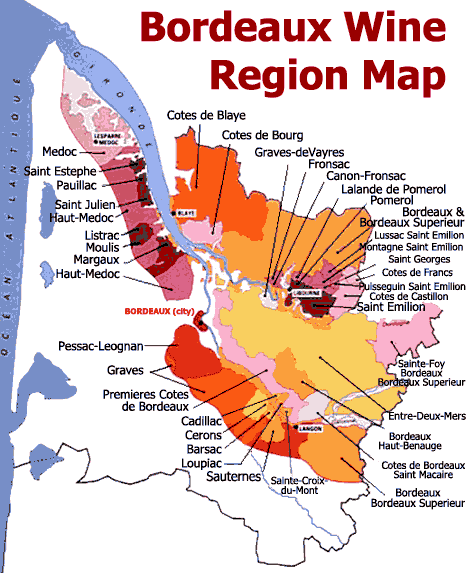
Haut- Medoc Rouge 2010. This Bordeaux blend from the Left Bank is a great value
from an area where wine prices can get astronomical. Left Bank wines are
usually Cabernet Sauvignon predominant,
and this is indeed primarily Cabernet, tempered and rounded
Chateau Aney
Haut- Medoc Rouge 2010. This Bordeaux blend from the Left Bank is a great value
from an area where wine prices can get astronomical. Left Bank wines are
usually Cabernet Sauvignon predominant,
and this is indeed primarily Cabernet, tempered and rounded  Last but not
least, we poured a wonderful Whisky, Bastille. When thinking of Whisky, nobody
thinks of France – at least until they try this. It is distilled from barley
and wheat and is aged primarily in French Limousin oak for five to seven years.
It has a floral, fruity nose with a hint of cinnamon. On the palate, it is
slightly sweet and honeyed, with a bit of clove, cinnamon and nutmeg. This is a
beautiful whisky that is best enjoyed
neat and is a bargain at $30.00.
Last but not
least, we poured a wonderful Whisky, Bastille. When thinking of Whisky, nobody
thinks of France – at least until they try this. It is distilled from barley
and wheat and is aged primarily in French Limousin oak for five to seven years.
It has a floral, fruity nose with a hint of cinnamon. On the palate, it is
slightly sweet and honeyed, with a bit of clove, cinnamon and nutmeg. This is a
beautiful whisky that is best enjoyed
neat and is a bargain at $30.00.
Dion’s
cookbooks combined with her delightful personality, great wines being poured, a
few morsels demonstrating her expertise…topped off with a sip of a great
whisky…make my job very easy to enjoy.
Cheers!