 Customers
are afraid of the Bordeaux section because first, they figure it will be
expensive, and second, they don’t understand what they are reading on the
label. Have no fear. Simply put, a red Bordeaux wine is a wine produced in the
Bordeaux region of France. It is the largest French wine producing area,
composed of over 120,000 hectares of vineyards and producing over 700 million
bottles of wine each year.
Customers
are afraid of the Bordeaux section because first, they figure it will be
expensive, and second, they don’t understand what they are reading on the
label. Have no fear. Simply put, a red Bordeaux wine is a wine produced in the
Bordeaux region of France. It is the largest French wine producing area,
composed of over 120,000 hectares of vineyards and producing over 700 million
bottles of wine each year.
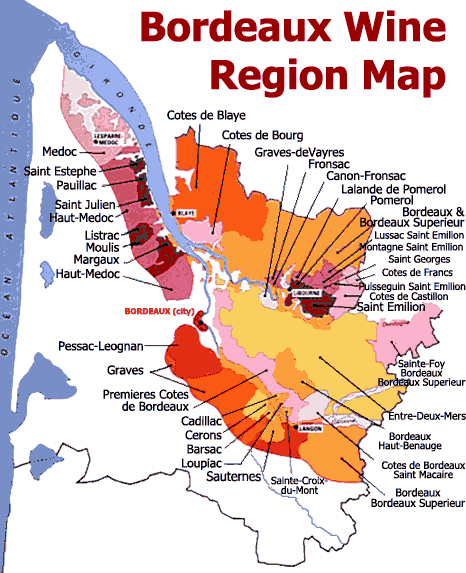
The region’s
hub is the city of Bordeaux, which sits on the west bank of the Gironde River
and runs from southeast to northwest on its course to the Atlantic Ocean in
west central France. Just north of Bordeaux, the Dordogne River empties into
the Gironde from the southeast, forming a “Y”. The Estates along the western
bank of the Gironde are known as “Left Bank” and those along the east bank of
the Dordogne are known as “Right Bank.” The area between the two arms of the
“Y” is known as “Entre Deux Mers” (“between two seas.”)
Why do we care about
all this? Here's why:
By law, only
six grapes that can be included in red wines from Bordeaux—Cabernet Sauvignon,
Merlot, Cabernet Franc, Malbec, Petit Verdot, and Carmenere. The first two are by far the largest contributors. The climate and the soils are vastly different on
the Left and Right Banks—so much so that Cabernet Sauvignon grows far better
on the Left Bank, and Merlot and Cabernet Franc far better on the Right Bank
and in Entre Deux Mers. Consequently, Left Bank wines are Cabernet predominant and
therefore more tannic, structured, and long lived as a rule (and less
approachable at an early age.) The wines from the Right Bank are Merlot driven,
with Cabernet Franc as an important component and much less Cabernet Sauvignon.
Right Bank Bordeaux tends to have lusher fruit, somewhat softer tannins, and
can be enjoyed at an earlier age. So when you come to the store, you’ll know which
“Bank” of Bordeaux you prefer.
 If only the
label on the wine said “Left” or “Right” Bank, the world would be perfect, but
that would be too easy. Instead, the label will usually indicate the
appellation, and you should leave it up to your wine geek to know that Medoc,
Haut Medoc, Margaux, St. Estephe, Graves, and St. Julian are all Left Bank, and
Pomerol, St Emillion, and Canon-Fronsac are Right Bank. As long as you know
what style you like, you will get a wine you love.
If only the
label on the wine said “Left” or “Right” Bank, the world would be perfect, but
that would be too easy. Instead, the label will usually indicate the
appellation, and you should leave it up to your wine geek to know that Medoc,
Haut Medoc, Margaux, St. Estephe, Graves, and St. Julian are all Left Bank, and
Pomerol, St Emillion, and Canon-Fronsac are Right Bank. As long as you know
what style you like, you will get a wine you love.
In 1855,
Napolean III requested that Bordeaux wines be classified into five levels, or
growths, according to the amount of money they commanded. Four first growths
were named—Lafite Rothschild, Margaux, Haut Brion, and Latour. In 1973, Mouton
Rothschild was added. All five of these wines are from the Left Bank and cost
upwards of $1000.00 per bottle upon release. Even fifth growths which fifteen years
ago could be purchased for $30.00-$45.00 now cost over $100.00. Although the
Right Bank wines aren’t in this classification, Chateau Cheval Blanc, Chateau
Petrus, and Chateau le Pin are still in these price ranges.
 Because of
these crazy prices, most of us will never get a chance to try these wines, which
fuels the idea that Bordeaux is only for the rich. This is not true. Although the first through fifth growths are the most
famous fifty or so wines from the Left Bank, and about twenty similar wines exist
from the other side, over 8400 other Bordeaux producers remain. These “petits
chateaux” produce very nice wines for $40.00, $25.00, and even $15.00. These
wines express the terroir and varietal character of the appellation where they
are grown and are pleasant to drink often upon the day of bottling. They don’t
age like the classified growths but will improve over three or four years.
Because of
these crazy prices, most of us will never get a chance to try these wines, which
fuels the idea that Bordeaux is only for the rich. This is not true. Although the first through fifth growths are the most
famous fifty or so wines from the Left Bank, and about twenty similar wines exist
from the other side, over 8400 other Bordeaux producers remain. These “petits
chateaux” produce very nice wines for $40.00, $25.00, and even $15.00. These
wines express the terroir and varietal character of the appellation where they
are grown and are pleasant to drink often upon the day of bottling. They don’t
age like the classified growths but will improve over three or four years.  Bordeaux
wines as a rule are made from rather tannic grapes and they are aged in oak, so
they’re going to be tannic. Don’t look to these wines for sipping at a cocktail
party or drinking on their own by the fire one evening. These are food wines.
They have aromatics and flavors of red and black fruit, with solid structure
and good acidity. They tend to be a bit lower in alcohol than their California
counterparts. These characteristics are typical of the cooler climate in
Bordeaux. Because the climate is cool, year to year variance can be marked.
Time of last frost, daily temperatures, and amount and time of rainfall all
have a huge influence on the quality of wine in a given year. Be sure to ask
your wine specialist which vintages to avoid or look for, or which are best for
drinking early or putting away for a few years.
Bordeaux
wines as a rule are made from rather tannic grapes and they are aged in oak, so
they’re going to be tannic. Don’t look to these wines for sipping at a cocktail
party or drinking on their own by the fire one evening. These are food wines.
They have aromatics and flavors of red and black fruit, with solid structure
and good acidity. They tend to be a bit lower in alcohol than their California
counterparts. These characteristics are typical of the cooler climate in
Bordeaux. Because the climate is cool, year to year variance can be marked.
Time of last frost, daily temperatures, and amount and time of rainfall all
have a huge influence on the quality of wine in a given year. Be sure to ask
your wine specialist which vintages to avoid or look for, or which are best for
drinking early or putting away for a few years. So tonight
you are having a dinner of beef, lamb, or game. Bordeaux is an excellent
choice. If you want to splurge a bit and like the structure of Cab based wines,
the Chateau Mongravey (Margaux) is
outstanding for $44.99. The Right Bank and Merlot predominant L’Excellence des Menuts at $42.99 is
drinking perfectly.
So tonight
you are having a dinner of beef, lamb, or game. Bordeaux is an excellent
choice. If you want to splurge a bit and like the structure of Cab based wines,
the Chateau Mongravey (Margaux) is
outstanding for $44.99. The Right Bank and Merlot predominant L’Excellence des Menuts at $42.99 is
drinking perfectly.
Bordeaux
doesn’t have to be complicated and it certainly doesn’t have to be expensive.
Wines from this area have been among the most renowned in the world for
hundreds of years. It’s time you found out what all the fuss is about. You will
be glad you did.
You can “bank” on it!


.jpg)