Showing posts with label Cabernet Sauvignon. Show all posts

Tuesday, April 23, 2013

South African Wines—Too Funky or Worth Exploring?


Viticultural history in South Africa is a roller coaster of success vs. disaster. The signature grape, Pinotage, is about as controversial a grape as ever.

South Africa’s history of wine production began in 1659, when the Dutch East India Company ordered the founder of Cape town, Jan van Riebeck,to make wine to help fight scurvy among the sailors during their voyages along the Spice Route. In 1685, the Constantia Estate was founded for that purpose. The estate fell into disrepair in the early 1700s but was rebuilt in 1778 when Hendrik Cloete purchased it. Soon this estate’s wines were famous throughout the world and coveted by the likes of Napolean Boneparte, King Louis Phillipe of France, and Frederick the Great of Prussia. The rest of the country’s wine production was largely unsuccessful, however. High-yielding inferior grapes such as Cinsault were planted in huge numbers, and by the early 1900s, some producers were dumping unsold insipid wine into rivers and fields. Apartheid and the resulting worldwide boycott of South African goods didn’t help the situation. The country’s wines were basically nonexistent in the foreign marketplace.

When apartheid was lifted in the 1980s, South African wines expressed a renaissance. Many producers adopted new technologies and planted well known varietals such as Syrah, Cabernet Sauvignon, Sauvignon Blanc, and Chenin Blanc (called Steen). This replaced Cinsault, which now comprises less than two percent of total plantings. Red varietals have exploded. In the late 1990s, less than eighteen percent of the grapes produced were red; now about half are.

The red wines from South Africa have had a reputation for being very rustic and course. New techniques have resulted in a more international fleshy style. However a certain earthiness remains that signifies a South African Cabernet or Syrah. This is not at all unpleasant, in fact I really like some of them, but if you’re new to South African wine you may find them a bit unusual. American consumers will frequently come across wines called “Cape Cross” or “Cape Blend.” These are usually blends of Syrah or Merlot, Cabernet Sauvignon, and Pinotage, and they are often really good wines.

As for the white wines, Sauvignon Blanc does very well here, with a flavor profile roughly between a California and New Zealand expression of the grape. Wines made from Chenin Blanc, known as “Steen,”  rival the Vouvrays of the Loire Valley.

Now, for the controversial “love it or hate it” grape—Pinotage. In 1925, Abaraham Izak Perold crossed the very robust Cinsault (known as Hermitage in South Africa) with Pinot Noir, a grape that produces great wines but is very difficult to grow. He planted four seeds in the residential garden and promptly forgot about them. The plants were rediscovered several years later. The first wine was made in 1941 and Pinotage was born. After a Pinotage wine won the Capetown Wine Show’s championship in 1959, the first label with the word “Pinotage appeared in 1961.

Pinotage typically has a characteristic flavor profile of smoky bramble, dark fruit, and earth. Aromatics of banana and tropical fruit are common. However, the acetone aromas turn some people off. This can result in very unusual descriptions. My colleague Jessica once said a badly made Pinotage smells like “Beaujolais Nouveau and a tire got together and had a baby.” I would add that the baby is lying in a manure pile.

I’ve got you all wanting to run out and get a Pinotage, right? Before I start a war with South Africa, let me say that if you choose carefully, Pinotage can be a really neat, funky, geeky wine that I enjoy a great deal. Pinotage adds a smoky earthiness to Cape Crosses that makes these wines very interesting.

Anyone with an interest in wine should experience a good Pinotage. Barista 2011 is just such a wine. Rich aromas of chocolate, coffee, plum, and mulberry with a hint of Maraschino cherry carry through to the flavor profile, with the addition of a bit of vanilla and butterscotch. The smoky earthiness reminds you that this is a Pinotage (a very good one.) This wine is a bargain at $17.99. Another good Pinotage to try is Painted Wolf Guillermo 2010, with lots of ripe blueberry and mulberry, spice, and bramble. The tannins are ripe and the finish quite lingering for a Pinotage. Again at $17.99.

Stellekaya is a great producer in Stellenbosch. I especially like their blends. The Cape Cross (fifty percent Merlot, thirty percent Pinotage, and twenty percent Cabernet) is aged in French oak for twenty months. With wonderful aromas and flavors of mint, fresh and stewed fruits, and mulberries, it’s done in a fleshy new world style but still funky because of the Pinotage in the blend. They also do a blend called Hercules (fifty percent Sangiovese, twenty-five percent Merlot, twenty-five percent Cabernet Sauvignon) which is like something out of Tuscany except the Sangiovese component is a bit fleshier and rounder. Earth, red berry, and supple tannins make this full flavored wine worth trying. Both are $21.99. 

Not to be lost among the big reds are the very well done whites. For a prime example of Sauvignon Blanc, look no further than the original great estate of South Africa, Groot Constantia Langoed Sauvignon Blanc 2011. Wonderful flavors of gooseberries, guava, and green bell pepper follow a typical grassy herbal nose. The background minerality is reminiscent of a cool climate Sauvignon Blanc like a Sancerre from the Loire Valley, but with more fruit. $22.99 may seem a bit steep until you try it and realize it’s worth it.

So don’t forget South Africa. The country is producing better and better wines and the good ones are worth the effort it takes to find them. Ask your local wine guy (or gal) about the best of the bunch.

Tuesday, March 26, 2013

Easter Wines


Easter means a food fest and a food fest means good wine.

Ham

One of the most popular main courses for Easter is, of course, ham. Ham is not as easy to match as you might think, although the mix of sweet and salt brings some great possibilities. For the white drinker, Riesling is an excellent choice. Get one with just a touch of sweetness, which rounds out the saltiness and has the good acidity to support the sweetness and fruit of the wine. My choice from Washington is Kung Fu Girl. From Germany, go with a Kabinett, like Dr. Loosen Blue Slate ($20.99.) Another white to try is Joseph Cattin Gewurztraminer from Alsace. Big fruit, spice, and a bit of residual sugar work very well with the ham.

For the red drinker, a big fruit-forward wine works well, such as a California Zinfandel.  Seven Deadly Zins or Dashe are good examples. Even better would be a Nero D’Avola or Negroamaro form southern Italy. These are similar to Zinfandels only a little lighter on the alcohol, a little earthier, and a little more elegant. Occhipinti’s TAMI Nero D’Avola is awesome at $18.99 and N Zero is a $12.99 Negroamaro that will make your ham wonderful.

Lamb

If you are lucky enough to live in a house where your wife doesn’t think lambs are too cute to cook, then nothing is better for Easter dinner. As far as I’m concerned, the perfect match for lamb is a red from the northern Rhone. These earthy Syrahs bring out the gamey rich flavor of the lamb like nothing else can. J.L. Chave is one of the Rhone’s great producers, and his Croze-Hermitage Silene ($27.99) or his St. Joseph  Offerus ($29.99) will guarantee a return invitation to dinner. For less money, a southern Cotes du Rhone blend such as Chateau Pesquie Terrasses ($15.99) will do fine.  If you don’t want French, a nice Spanish Rioja like Zuazo Gaston ($14.99) or a big Nebbiolo such as Dominico Clerico’s Capisme-E 
($37.99) are excellent choices.

Prime Rib

A marbled prime rib literally screams out for a big tannic wine like a California mountain Cabernet. Staglin’s 2007 Salus at $89.00 is epic, but Mt Veeder ($35.99) and Educated Guess ($20.99) are both very nice. Even better is Aglianico, a tannic, rustic monster from southern Italy. San Martino’s SIIR at $19.99 is a true bargain. Taurasi is the world’s greatest expression of this grape. If you brought a bottle of Mastroberardino Radici 2006 ($63.99) to my house, you’d get a lifetime invitation to dinner anytime you want. But you don’t have to spend a lot of money to enjoy your prime rib properly. 1907 Madiran from southwestern France (home of the Tannat grape) is a wonderful accompaniment for a whopping $12.99.

Brunch

Last but not least, Easter Brunch. If you are looking forward to those mimosas, Spanish Cavas and Proseccos are great bang for your buck and they have big exuberant bubbles that will stand up to your O.J. Sonim is a great Cava for $13.99 and Le Colture Sylvoz at $12.99 is my favorite Prosecco for the job. Don’t bring a nice Champagne from France. The very fine bubbles will flatten in about ten seconds if you add O.J., peach nectar, or Kirsch…very unimpressive indeed.

These are by no means your only choices, especially if you’re having a different or unique food for Easter. And for dessert? You may have to consider a nice Port for all that chocolate.

Above all, though you may not eat responsibly, please drink that way. Happy Easter!

Tuesday, March 5, 2013

Red Bordeaux—Expensive and Confusing?
Nope… Hints to “Bank” On


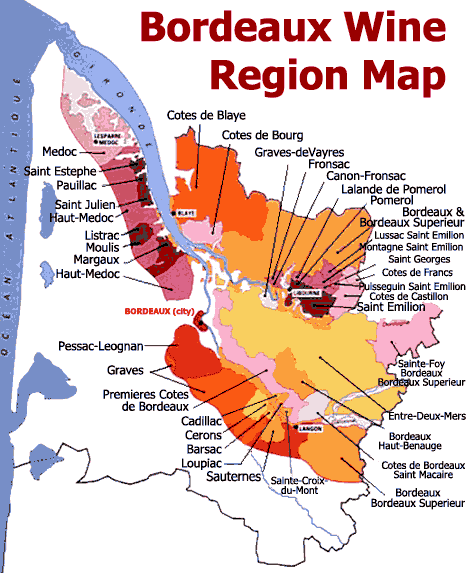
Customers are afraid of the Bordeaux section because first, they figure it will be expensive, and second, they don’t understand what they are reading on the label. Have no fear. Simply put, a red Bordeaux wine is a wine produced in the Bordeaux region of France. It is the largest French wine producing area, composed of over 120,000 hectares of vineyards and producing over 700 million bottles of wine each year.

The region’s hub is the city of Bordeaux, which sits on the west bank of the Gironde River and runs from southeast to northwest on its course to the Atlantic Ocean in west central France. Just north of Bordeaux, the Dordogne River empties into the Gironde from the southeast, forming a “Y”. The Estates along the western bank of the Gironde are known as “Left Bank” and those along the east bank of the Dordogne are known as “Right Bank.” The area between the two arms of the “Y” is known as “Entre Deux Mers” (“between two seas.”)

Why do we care about all this? Here's why:

By law, only six grapes that can be included in red wines from Bordeaux—Cabernet Sauvignon, Merlot, Cabernet Franc, Malbec, Petit Verdot, and Carmenere. The first two are by far the largest contributors. The climate and the soils are vastly different on the Left and Right Banks—so much so that Cabernet Sauvignon grows far better on the Left Bank, and Merlot and Cabernet Franc far better on the Right Bank and in Entre Deux Mers. Consequently, Left Bank wines are Cabernet predominant and therefore more tannic, structured, and long lived as a rule (and less approachable at an early age.) The wines from the Right Bank are Merlot driven, with Cabernet Franc as an important component and much less Cabernet Sauvignon. Right Bank Bordeaux tends to have lusher fruit, somewhat softer tannins, and can be enjoyed at an earlier age. So when you come to the store, you’ll know which “Bank” of Bordeaux you prefer.

If only the label on the wine said “Left” or “Right” Bank, the world would be perfect, but that would be too easy. Instead, the label will usually indicate the appellation, and you should leave it up to your wine geek to know that Medoc, Haut Medoc, Margaux, St. Estephe, Graves, and St. Julian are all Left Bank, and Pomerol, St Emillion, and Canon-Fronsac are Right Bank. As long as you know what style you like, you will get a wine you love.

In 1855, Napolean III requested that Bordeaux wines be classified into five levels, or growths, according to the amount of money they commanded. Four first growths were named—Lafite Rothschild, Margaux, Haut Brion, and Latour. In 1973, Mouton Rothschild was added. All five of these wines are from the Left Bank and cost upwards of $1000.00 per bottle upon release. Even fifth growths which fifteen years ago could be purchased for $30.00-$45.00 now cost over $100.00. Although the Right Bank wines aren’t in this classification, Chateau Cheval Blanc, Chateau Petrus, and Chateau le Pin are still in these price ranges.

Because of these crazy prices, most of us will never get a chance to try these wines, which fuels the idea that Bordeaux is only for the rich. This is not true. Although the first through fifth growths are the most famous fifty or so wines from the Left Bank, and about twenty similar wines exist from the other side, over 8400 other Bordeaux producers remain. These “petits chateaux” produce very nice wines for $40.00, $25.00, and even $15.00. These wines express the terroir and varietal character of the appellation where they are grown and are pleasant to drink often upon the day of bottling. They don’t age like the classified growths but will improve over three or four years.

Bordeaux wines as a rule are made from rather tannic grapes and they are aged in oak, so they’re going to be tannic. Don’t look to these wines for sipping at a cocktail party or drinking on their own by the fire one evening. These are food wines. They have aromatics and flavors of red and black fruit, with solid structure and good acidity. They tend to be a bit lower in alcohol than their California counterparts. These characteristics are typical of the cooler climate in Bordeaux. Because the climate is cool, year to year variance can be marked. Time of last frost, daily temperatures, and amount and time of rainfall all have a huge influence on the quality of wine in a given year. Be sure to ask your wine specialist which vintages to avoid or look for, or which are best for drinking early or putting away for a few years.

So tonight you are having a dinner of beef, lamb, or game. Bordeaux is an excellent choice. If you want to splurge a bit and like the structure of Cab based wines, the Chateau Mongravey (Margaux) is outstanding for $44.99. The Right Bank and Merlot predominant L’Excellence des Menuts at $42.99 is drinking perfectly.

Want to spend less and still drink well? From the Left Bank we have the Chateau Le Pey (Medoc, $16.49) and Chateau Beauregard Lagupeau (Graves, $16.99), and from the Right we have La Croix Bonnelle (St. Emillion, $16.99) and La Croix Meunier (St. Emillion, $24.99). These are all nice examples of Bordeaux at reasonable prices. There are others in the $10.00-12.00 range that will amaze you.

Bordeaux doesn’t have to be complicated and it certainly doesn’t have to be expensive. Wines from this area have been among the most renowned in the world for hundreds of years. It’s time you found out what all the fuss is about. You will be glad you did.

You can “bank” on it!

Monday, February 25, 2013

Southern Italian Reds—Strange Names, Wonderful Wines


One of the great things about Italian wines is that you can buy a different varietal every week and still be sampling new ones six months later. Over a thousand different grapes are vinified in Italy. This, combined with the fact that Italian wine labels often indicate the origin rather than the type of grape the wine is made from, can make walking the Italian aisle a frightening experience. But the wines are extraordinary, can be great alternatives to the usual fare, and can make you look really smart in the process.

A perfect example is a grape called Negroamaro which is grown almost exclusively in Puglia (the heel of the boot” ). When people are in the California Zinfandel aisle, I often suggest this as an alternative—same big fruit but a point or two lower in alcohol (so not as “hot” as some Zins), not over baked (some Zins get a little raisiny) and more elegant and earthy. The grape’s name translates to “black and bitter” and does have a bitter black cherry finish sometimes. It tends to be deep in color and robust and earthy with big aromas and flavors of dark fruit. Around the town of Salento, the Negroamaro is often blended with the very fragrant Malvasia Negro to make a complex big wine, Salice Salintino, which can be marvelous. We are talking about prices in the twelve to sixteen dollar range, so they are great bargains. One of my favorites is N Zero, 100% Negroamaro at $12.99. Leone de Castris Salice Salentino at $15.99 is a no brainer. 

Sicily is known for the Mafia, Mount Etna, and great food. Thanks to some up and coming winemakers, it is also becoming known for its indigenous grape, Nero d’Avola. Once mainly a blending grape in bulk wines, spectacular examples of wine from this grape are emerging and should not be missed. These wines are dark in color, big in dark fruit flavors, earth, and smoke with moderate tannins. Arianna Occhipinti is a rock star winemaker only in her late twenties who is putting Sicily on the map with her organically grown wines. Her elegant, complex TAMI Nero d’Avola shows the heights this varietal can reach—a bargain at $18.99.

When people come into the store looking for a wine to go with a ribeye dinner, they are usually standing in the California Cabernet section. I have no argument against a big, tannic, mountain-grown Cab as a great match to the well-marbled meat. Likewise, a left bank Bordeaux is wonderful. But as you might guess, the southern Italian section offers a perfect alternative.

Aglianico is a monster grape grown in the Basilicata and Campania regions of southern Italy. Italian wine is my first love, and this may be my favorite varietal of all. Originally introduced by Greek settlers, it has become one of Italy’s finest grapes. The grape produces wines of huge dark fruit, massive tannins, and a bracing acidity which makes very age-worthy. The wine is known as “The Barolo of the South,” after the Nebbiolo-based Barolos of Piedmont that can age for decades (and cost hundreds of dollars). They boast aromas and flavors of dark fruit, dark chocolate, coffee, leather, smoke, and mineral. In Basilicata, these grapes are grown around the ancient volcano Monte Vulture and comprise the region’s only DOCG. In Campania, the grapes are grown around the town of Taurasi, and the wines and the DOCG have the same name.

Mastroberadino’s 2005 Taurasi Radici may be one of my favorite wines of all time. It is absolutely massive with dazzling power and depth—believe it or not, a bargain at $63.99. For the more moderate pocketbook, a humble farmer makes a version of this wine that I keep in my house at all times. San Martino Siir Aglianico de Vulture is the best $19.99 wine you’ll ever pour next to a giant medium-rare prime rib. This wine is biodynamically farmed and has a wonderful rustic quality that will hook you.

These three varietals are only a tiny sample of what you can find in the vineyards of Italy. I have customers who I take on Italian shopping trips through the store every week or two. They first come in totally lost and afraid to sample them, and before they know it, they’re addicted. As far as addictions go, there are far worse.

Cheers!

Wednesday, February 13, 2013

I’d LOVE to Come to Dinner…What Wine Should I Bring?


Making dinner for the spouse’s boss? Or someone you consider knowledgeable about wine? Afraid you’ll look ignorant by serving the wrong wine?

Don’t panic. Though the Sommelier at the local five star restaurant might like you to think otherwise, food and wine matching is not rocket science. Today I’ll give a few simple survival tips to make you look wine savvy and make your dinner a success.

First, don’t ask what’s on the menu. That way, your bottle of wine is just a gift, and if the person making dinner knows wine, he’d probably rather open his own anyway. Of course, this won’t work if you already know what’s for dinner or if you are the one preparing the meal.

When matching a wine to a meal, consider these three components:

Structure – body/weight, acid and sugar levels

Flavors – The five basic flavors perceived by the taste buds are sweet, bitter, salty, sour, and umami. The last one is tough to explain. It’s a “savory, meaty pleasant taste that gives a sensation of coating the tongue.” However, there are millions of “flavors” which affect the taste of other foods and of wine.

Textures – soup vs. steak vs raw oysters.

Now, some basic rules to live by:

  1. The body and weight of the wine should match the food (light with light, full with full.) Otherwise one will overwhelm the other. If the wine is lighter bodied, it must be powerful enough in flavor and high enough in acid to stand up to the food. If you are having a simply prepared chicken dish, a Cabernet Sauvignon will completely overwhelm it If you are having a grilled rib eye, a Pinot Noir or a light white wine probably will get lost.
  2. Alcohol balances weight and body in food. Alcohol accentuates spice – big time - and provides great balance to sugar and salt. If you are making a ham, the sweetness and saltiness of the meat would work well with a wine with a higher alcohol level. Sweetness and fruitiness also work great with salt and spice. A big California Zinfandel like Saldo by Orin Swift, with its highly extracted fruit and high alcohol, works great. However, if you are having a spicy chile con carne, the high alcohol in the wine will make dinner literally a painful experience. This is why the best wine match for Indian food is beer, with its low alcohol compared to wine. If you want to do white with your salty ham or your spicy Thai food, go with one a slightly sweeter one – perhaps a nice Riesling from Germany like Dr Loosen Blue Slatelate Kabinett. Acid is really important. Acid is the component in wine that makes you salivate and makes your eyes involuntarily close when you sip it. It also stimulates you to eat and drink more. It balances food and seems to separate and bring out the highlights of food ingredients. The acidity in the wine must match or exceed the acidity of the food or the wine will appear dull and flabby. The best wines to drink with food have a naturally higher acidity, which is why old world wines, with their higher acidities and lower alcohol, work so well with food. New world wines, with their higher fruit concentration, higher alcohol, and lower acidity, are better by themselves. A glass of high-acidity Chianti might not be very pleasant by itself, but have pair with a plate of pasta in a tomato based sauce (a high acid dish) and it shines. A low acid red like a California Cabernet won’t work as well with this dish.
  3. Oak, especially in white wine, does not always enhance its “food friendliness.” Oak rounds out a white wine and gives it flavors of vanilla. These wines also undergo a specific type of fermentation that gives them a buttery flavor. Vanilla and butter don’t go particularly well with a lot of simple dishes made from seafood and chicken, so a heavily oaked Chardonnay will overwhelm them. Higher acid wines with more vibrant fruit not hidden by oak often work better, like a Calera Fiano from Sicily or a Sancerre from France. Oak works much better with red wines, adding complexity and roundness that reins in the fruit a bit. Rich braised meats like Osso Bucco are amazing with a well-oaked Barolo like Roagna or a Bordeaux.
  4. Tannins can be your friend…or not. Tannin is the component of red wine that makes you feel like you have a clove in your mouth. It dries your mouth and gums. It is a preservative in the wine and originates from the skin and stems and from oak barrels. As a wine ages, the tannins soften, which is why aged red wines become easier and more pleasant to drink than at release. Tannins interact beautifully with fat and protein. The tannins become soft and almost sweet and the meat becomes juicier to the senses and more savory. This is why the classic match of a ribeye with a big tannic Cabernet Sauvignon, Rioja, or Brunello works so beautifully. But tannins work poorly with acid, so don’t drink your Cab with lasagna, and if you drink a tannic wine with fish, not only does the red overpower the fish but the tannins get a metallic taste so the wine performs poorly. If you like red wine with fish, get a light to medium bodied wine with good acidity and little tannin. Beaujolais from France or a fruity Pinot Noir works just fine.
  5. Sauces often dictate the wine, as does the method of cooking. If you are making seafood in a white garlic sauce, the dish needs a white wine. If you are cooking it in a marinara sauce, you need a high acid red like Mauro Molina Barbera. If you are grilling your beef, a nice Malbec, like Durigutti or Renacer Punto Final from Argentina works great. If you are going to braise it, a nice oaked wine with some age to soften the tannins works better.
  6. If the food is from there…go with the wine from there. If you are having Seafood in a white or simple sauce, try a white from Sicily where they eat seafood every meal. If you are having southern Italian food, Southern Italian wines will go great. Lamb is everywhere in the southern Cotes du Rhone. Wanna bet on a red Cotes du Rhone red working well? Argentina is famous for its grilled meat. Argentinian Malbec is about as good as it gets with barbeque.
These are just a few things to think about when matching your food and your wine. Most of all go with what you like and know. If you’ve never had Alsacian Gewurztraminer, don’t try it for the first time with your dinner if you’re not willing to suffer the consequences of a good match. Red wine with fish, Champagne with popcorn…whatever works for you. Don’t be afraid to ask your local wine merchant. Many have a good knowledge of what works. This is especially true with tough matches. Are you having artichokes, asparagus, and eggplant? They'll know you need Gruner Veltliner. Cheers!

Saturday, January 12, 2013

Looking for Power AND Elegance in your Red Wine? You Want Priorat!


Spain is a place for wonderful value. Big bold wines, sometimes with surprising complexity, are available for very little money. For some very serious and elegant wines, look no farther than Priorat.

Priorat is a tiny appellation of about 1800 hectares (4400 acres) of vines just southwest of Catalonia in Northeast Spain. It began getting recognition for its powerful yet elegant red wines in the 1990s. Priorat is one of the only two regions to qualify as a DOCa, the highest quality in Spain (Rioja is the other).

The prior of the monastery of Scala Dei introduced viticulture in this region in the late 1100s, hence the name Priorat. All the vineyards were tended by monks until 1835 when they were expropriated by the state and distributed to small holders. At the end of the nineteenth century, phylloxera devastated the vineyards and caused economic ruin and mass emigration from the area. The vineyards were replanted in the 1950s.

The soil in Priorat is an unusual mixture of black slate and mica called llicorella. This soil holds heat (but not water) well. Many of the vineyards are on extremely steep slopes and require hand harvesting. On this rocky soil, the traditional grape varietals of Garnacha and Carinena flourish; many vines are fifty to one hundred years old. Also authorized in the region are Cabernet, Syrah, and Merlot, which are becoming more popular in the blends, although the traditional grapes make up the majority of the mix. Some white grapes are grown, but they make up less than four percent of the total harvest.

Because of the climatewhich is harsher than usually seen in temperate areas, the rocky soil, and the steep hillsides, yields are low and the cost of making the wine is higher than most of Spain. Prices average in the $25.00 to $50.00 range and can reach well over $100.00 per bottle. However, there are some awesome wines available that won’t hurt your cash flow and will still give you an excellent introduction to the wonder of this region.

The Alvaro Palacios Camins del Priorat 2010 is a perfect place to start. This blend of Garnacha, Carinena, Cabernet Sauvignon, and Syrah stays true to the vision of Priorat—powerful yet elegant, approachable but restrained. The perfumed nose displays dark berry preserves, licorice, minerals, and pungent flowers. There are sweet vibrant flavors of black raspberry, cherry, minerals and white pepper. It is dense and chewy but lively. The finish is well defined and gently tannic. This wine grossly outperforms its price point of $22.99.

The Onix Classic 2010 is a blend of fifty percent old vine Garnacha and fifty percent old vine Carinena and is one of the best values in the Priorat. The wine is completely unoaked. There is a lovely nose of mineral, black cherry, plum, and Asian spice. The wine is intensely flavored with blackberry, black cherry, tea, and cinnamon . There is a lengthy finish of leathery tannins—a lot of wine for $20.00.

The Vall Llach Embruix 2008 is outstanding and acts like a $50.00 wine in a $26.99 bottle. This is a blend of Garnacha and Carinena from fifty to ninety year old vines, along with a bit of Merlot, Syrah, and Cabernet Sauvignon. The wine is aged fourteen months in used oak. There are beautiful aromatics of mature dark  fruits, minerals, tar, leather, and spice, with a hint of freshly roasted coffee. The palate suggests warm berry compote followed by espresso and dark chocolate. Very full bodied and complex, yet elegant—a great bottle of wine.

Spanish wines are sexy, spicy, and fun to drink. There are wonderful Garnachas, Tempranillos, Mencias, and Monastrells from all over Spain at great prices to enjoy with tapas and barbeques, but don’t neglect the serious wines found in the Rioja and especially in the tiny picturesque region of Priorat.

Monday, August 6, 2012

FUN WITH THE BLENDER
GREAT RED WINES


Many people who come in the store look for specific varietals of wine…Cabernet, Chardonnay, etc. However, many wines are blends of two or more different grapes. The different grapes contribute different aspects to the flavor profile of the wine. One grape may add structure, another may supply dark fruits, and another may add spice. As a result, the wines can be remarkably complex and flavorful.

Many countries in Europe label their wines by the region where they are grown (Bordeaux, Chateauneuf du Pape) rather than the type of grape in the bottle, and these are very often blends of several grapes.

Bordeaux wines can contain up to five specific grapes—Cabernet Franc, Cabernet Sauvignon, Merlot, Petit Verdot and Malbec. (Carmenere is also allowed, but almost never used). These wines tend to be dry, structured, and complex. Although some can cost over $1000.00 a bottle, many wonderful examples exist in the $10.00 to $20.00 range. Look for Chateau Vrai Caillou, Terrefort Lescalle and St. Elme.

Meritage (rhymes with “heritage”) is an American wine that contains a combination of the same grapes found in Bordeaux wines. Claret is yet another term for the same type of wine. Newton, Rodney Strong, and Franciscan are a few to look for. Lyeth makes a nice one for under $15.00.

Up to nine different grapes an be used in Chateauneuf du Pape, though Grenache, Syrah, and Mouvedre are the most common. These are complex age-worthy wines and can be very expensive. If you have $80.00 or $90.00 to spend, look for Mas de Boislauzon Quet or Janasse Chaupin  from the 2010 vintage. These are magnificent wines. For $30.00 you can drink a very nice example from Barrot. Chateauneuf du Pape is in the southern Rhone. Lots of wonderful inexpensive wines from the various villages that comprise the area nestled at the foothills of the mountains are available. They are usually blends of Grenache and Syrah with either Mouvedre, Carignan, or Cinsault added to the mix. They are great wines for a great price. Look for Boisson Cairanne, Chateau Pesquie, and Gassier Cercius, all under $20.00 and wonderful.

The blend of Grenache, Syrah, and Mouvedre has made its way from the Rhone Valley to Australia and the U.S. and has become so popular that they are referred to as “GSM” blends. John Duval’s Plexus and Two Hands Brave Faces are beautiful examples from “Down Under,” Stump Jump is a great example at a cheaper price.

In addition to the GSM formula, California produces many blends, combining Syrah, Merlot, Zinfandel, Petit Sirah, Tempranillo, Cinsault, Cabernet Sauvignon, Mourvedre, Grenache, Sangiovese, and Barbera—sometimes up to six or more in one wine. I like to call these “kitchen sink “ wines. Great examples are Orin Swift’s Prisoner at $40.00 and a much cheaper wine called The Culprit 2010 at $15.00.

Blended wines offer wonderful complexity and big flavors, often for great prices. Give them a try!

Sunday, June 10, 2012

DRINK TO YOUR HEALTH...LITERALLY
Madiran—No Spoonful of Sugar Required for this Medicine to go Down


Madiran is a small village in Basque-influenced southwest France just north of the Pyrenees. It is also an appellation, and it gained worldwide attention when Roger Corder published his 2007 book The Red Wine Diet and recommended Madiran wines as the most heart healthy in the world.

Corder’s research revealed that red wines contain procyanidin, an antioxidant that prevents heart disease. The Tannat grape, the basis of red Madiran wines, has more procyanidin than any other grape. Coincidentally, the lifespan of men in the Madiran district is among the highest in the world.

The Tannat grape produces tannic, complex wines with rich dark fruit and raspberry flavors and aromas of spice, coffee and vanilla. These wines have had a reputation of being fiercely tannic, requiring years of aging before being drinkable. Now, Tannat is often blended with Cabernet Sauvignon and/or Cabernet Franc which softens the tannin and results in a much more approachable wine.

Another way to soften tannins is a process called micro-oxygenation, introduced in 1991 specifically for Tannat grapes. Oxygen is introduced into fermenting wine in a controlled manner. This results in polymerization of the tannins into larger molecules which are perceived as softer.

1907 Madiran (Producteurs Plainmont and Cave Crousilles) is a spectacular example of the level of flavor, structure, and complexity these wines can reach at a $15.00 price tag. It is a blend of 70% Tannat, 20% Cabernet Sauvignon, and 10% Cabernet Franc.

The nose of spice, coffee, and cocoa is followed by a blast of dark fruits and raspberries layered against a background of tannin, licorice, minerals, and a beautiful acidity. The result is a remarkably complex wine for the price. Its unusual combination of power and freshness makes it a spectacular match for grilled steaks or barbecued ribs on the back deck.

The 1907 is named for the year the appellation was first defined. It is produced by independent growers jointly with two cooperatives.

Basques immigrating to South America brought Tannat there, and it is now widely grown and has, in fact, become the national grape of Uruguay. The wines there are much fruitier and less tannic, and  although good, are very different than the beautiful Tannats from Madiran, especially the 1907.

1907 Madiran is a must have wine. Find it and buy it—lots of it. As good as it now, it’ll probably be even better next year.

To your health!

Thursday, April 26, 2012

You Can Drink Rosé and Still Be a Bad Ass


All you macho types keep in mind these words coming from Charles and Charles (a joint project between Charles Smith and Charles Bieler). It’s spring...the beginning of Rosé season.

Rosé wines are made from red grapes. The grape skins have very limited contact with the juice which gives the wines a pink color. The shorter the contact, the lighter the color. While Rosé can be sweet, off dry, or bone dry, today I'm talking about the beautiful decidedly dry type.  The flavors of Rosé wines tend to be subtle versions of their red varietal counterparts—strawberry, cherry, watermelon, citrus, and raspberry.

These wines are perfect for spring and summer, as they are served chilled and are probably the most food friendly and food versatile wines on the planet. The light body and delicate flavors make them ideal picnic wines that go well with roast beef, chicken or ham sandwiches, egg or potato salad, and even chips and dip. They are great for backyard barbeques, easily handling burgers, hot dogs, chicken, and even steaks. And nothing is better than Rosé to drink with nothing at all on a bright summer day. They are also great values, most being in the 10 to 20 dollar range.

Rosés got a bad rap after the winemaker at Sutter Home invented White Zinfandel completely by accident (an arrested fermentation).  This started the flood of sweet wine cooler-like blush wines from California. Consequently, in the past I've had people run from the tasting bar when I did a Rosé tasting. Dry Rosé, though, is a wonderful wine, and sales are going up. People are finding pleasant surprises at store tastings even if all the wines are pink.

There are hundreds of Rosés on the market. I'm going to mention three that are reasonably priced, fairly easy to find, and outstanding.

Domaine du Salvard Cheverny Rosé 2011 screams “Loire Valley” with its strong minerality and beautiful acidity. It is a blend of 60% Pinot Noir and 40% Gamay. The nose and palate are full of rose petals, strawberries, bell pepper, and a bit of peaty earth. The finish is lingering and perfectly balanced.

Bieler Pere et Fils Rosé 2011 is from Provence, a renowned area of Rosé production. This deeply colored Rosé is Syrah driven (50%), blended with 30% Grenache and 20% Cabernet Sauvignon. It is cranberry red in color with a nose of raspberry, cherry, and wild strawberry. It is crisp and flavorful on the palate with a medium body and notes of red berries, cherries, and spice.  The finish is long and refreshing.

Feudi di San Gregorio Ros’aura Rosato 2011 is made from 100% Aglianico which is known for making very powerful tannic wines. The wine is a brilliant ruby color with a huge nose of freshly crushed strawberries and cherries. Medium bodied and intensely fruit driven with a palate of strawberry preserves, cherries, and a hint of green herbs, it has a lingering but crisp finish. This is a powerful Rosé, and has always been one of my favorites.

These wines are coming into stores in large numbers this time of year and can be found at great prices.  So all you guys, if your football coach invites you to dinner, be brave and grab a bottle of dry pink wine. He’ll be impressed with your wine savvy.