Monday, January 7, 2013

Take a Price Break After the Holidays—The Languedoc


January is here and we are all dealing with our credit card bills from the holidays, but have no fear—you don’t have to give up good wine! The Languedoc-Roussillon region of France offers up some affordable big, bold reds perfect for cold weather, as well as an interesting white to go with a healthy seafood dinner.

The Languedoc-Roussillon region spans the Mediterranean coastline from Spain to Provence. The area boasts 700,000 acres of vines and is the single largest wine producing area in the world. It accounts for over a third of France’s wine production, and as recently as 2001 produced more wine than the entire U.S. The region has been producing wines since the fifth century.

It is the hottest and most arid of France’s wine growing regions, which allows for full ripening and maturation of Syrah, Grenache, Carignan, Mourvedre, Mauzac, and Chenin Blanc. International varietals such as Cabernet, Merlot, and Chardonnay thrive there as well. The region is known for its fruit-forward, bold wines that are screaming values. Despite all this, it is probably France's least well-known wine region.

The Languedoc is divided into several appellations, the most well-known being Corbieres, Minervois, Limoux (the birthplace of sparkling wine), and Coteaux du Languedoc. The latter is further divided into several sub districts such as Pic St Loupe and Picpoule de Pinet. This results in a wonderful variety of wines.

Chateau Millegrand  Minervois 2010 is a blend of Syrah, Grenache, Mourvedre, and Carignan. This barrel-aged blend is perfumed with dark cherries, black pepper, and vanilla spice. Hints of herbs and minerals add to a rich palate of dense dark fruits and subtle oak. Although medium-bodied, it is well structured with a good backbone of fine tannins and restrained acidity. All for $13.99.

Chateau de Vaugelas Le Prieure Corbieres 2009 is a blend very similar to the previous wine. This 270 acre estate lies in the hills of Lagrasse, reputed to be the best of the Corbieres growing zones. This estate was the preferred source of wine for The Abbaye Lagrasse in the sixteenth century. (This monastery was an instrumental outpost for the merciless eradication of the Cathars and suppression of other alleged heretics). There is a powerful ripe flattering nose of black fruit and spices. It is warm and velvety on the palate with rich black fruit flavors. The finish is full and rich, with hints of chocolate. Simultaneously exuberant and elegant. Again at a bargain price of $12.99.

Domaine L’Hortus Le Loup Dans la Bergerie 2010 is a wonderful wine resulting from an ancient reclaimed vineyard squeezed between two mountain peaks in Pic St Loup. A blend of Syrah, Grenache, and Merlot grapes that are grown organically and aged entirely in stainless steel, this medium-bodied wine is fresh and lively with cherry and plum fruit spiked with white pepper, black tea, stone, and spice. Hortus is Latin for garden, and the French name literally means “The Wolf in the Sheep Pen.” The price is $11.99

My suggestion for a white is one of the oldest varietals in France, Picpoul. Its name means “lip stinger” and refers to the grape’s high acidity. Picpoul de Pinet is a designation which may be used if the wine is 100% Picpoul and made only in the town of Pinet. It can be recognized by the tall slender bottle embossed with the Languedoc Cross. Gerard Bertrand's bottling is full bodied with rich, slightly buttery green apple and lemon flavors and has remarkable freshness and acidity for a warm weather wine. It has a bright clear finish. This wine sees no oak and is meant to be drunk young. The appellation covers only 1300 hectares overlooking a lagoon where mussels and oysters are farmed (fitting, as this is a perfect seafood wine). The wine costs only $13.99.

Try a wine from the Languedoc-Roussillon region today. You’ll likely uncover a new favorite...and still pay off your holiday bills!

Monday, December 10, 2012

It’s Cold Out There…Time to Think Porto


With the onset of the cold weather, I start thinking of sitting by a fire with a plate of cheese (especially blue), apples, and nuts, and sipping on a nice Porto. This is such a wonderful ritual that it’s almost worth half freezing to death driving home after work to enjoy it.

Porto, or Port, is a wine produced in the Duoro Valley of northern Portugal. It is typically red and sweet, although dry white forms are occasionally seen. Port is fortified by the addition of a neutral spirit called aguadente that stops fermentation, leaving residual sugar and an alcohol content of 18-20%. It is then aged in barrels.

The Duoro Valley was defined as an appellation in 1756, making it the oldest in the world. Over 100 different  grapes can be used, but only five make up the vast majority—Tinta Barroca, Tinta Cao, Tempranillo, Touriga (most widely grown), and Touriga Nacional (considered the best but difficult to grow).

Red Port is found in several styles.

Tawny Port is aged in wooden barrels that expose it to gradual oxidation and evaporation. As a result, it gradually mellows into a golden brown color with a distinct nuttiness and viscosity on the palate. If a bottle of Port says simply “Tawny,” it has been aged in wood for at least two years. Designations of 10, 20, 30 and over 40 year old Tawny exist at markedly escalating costs. Most Port houses blend wines from several vintages to keep their style consistent. A Tawny from a single vintage is called a Coheita.

Ruby is the most common and the least expensive Port. After fermentation, it is stored in concrete or steel tanks to prevent oxidative aging. This keeps the fruit fresh and lively.  Reserve ports are usually rubies from the best lots of grapes.

Late Bottled Vintage (LBV) was wine that was destined to become Vintage Port but was left in barrel longer than planned, usually due to decreased demand.  So it is somewhat similar to a Vintage Port, but is softer and rounder because of the longer time in barrel, and usually a bit lighter in style.

Vintage Port is the most famous of the Ports, the rarest (less than 2% of all Port produced), and the most expensive, approaching $100.00 or more per bottle at release. This is made from grapes produced in a single year, and only if the harvest is of excellent quality (usually 3 or 4 times per decade). A vintage is declared in the second spring after harvest. The wine is aged for  a maximum of 2 ½ years in wood before bottling. Many require an additional 10, 20, or even 40 years before they reach their proper drinking age. They retain their ruby color and their fresh fruit, but are remarkably powerful and complex…and can remain drinkable for many decades.

There are many excellent Port houses.  Symington Family Estates owns the brands Graham, Dow, and Croft which are all good. Also excellent is the Fladgate Group (Taylor, Croft, and Fonseca). Most Rubies cost in the low teens, while the plain Tawnies cost in the mid teens. Ten year old Tawnies cost in the thirties and 20 year olds cost in the fifties and sixties. LBVs average twenty-five to thirty dollars.

When considering these prices, remember that these wines are thick, sweet, and powerfully flavored. They are meant to be drunk in much smaller amounts than typical table wine, and half a glass is usually more than enough. One bottle will give you lots of enjoyment!


Monday, November 12, 2012

Turkey Friendly Wines


Thanksgiving is again upon us, and the store will be full of people looking for that special wine to go with their holiday meal. I have a few suggestions.

A white wine must stand up to the myriad flavors that assault our taste buds at the holiday table, not be overpowered by them. My favorite choice is Gewurztraminer, especially those from Alsace. These spicy, full-bodied wines are an ideal choice to go with the yams, cranberry sauce, green bean casserole, and everything else…especially the bird. Domaine Trimbach does an especially fine job with this varietal.

Riesling, with its touch of sweetness and generous minerality works well too. Donnehoff Estate from Nahe and Darting Estate Kabinett from the Pfalz are both classic examples of what the Germans can do with this grape, and Kung  Fu Girl does Washington state proud. Vouvray, the Loire’s version of Chenin Blanc, is another appropriate choice, with its symbiotic blend of minerality, fruit, and flinty acidity. Try Varennes Du Clos.


Choices abound for the red wine lover. Probably the most commonly chosen is Pinot Noir. Its medium body, fragrant aromatics, and cherry flavors mingle gracefully with roasted fowl. Baus Family is a good example from California. Llai LLai is an extraordinary value from Chile, while Regis Bouvier’s En Montre Cul and Drouhin’s Chorey Les Beaune admirably represent Burgundy.

While I’m a big Pinot fan, especially of those from Burgundy, this year my red is going to be a Chinon, probably Jean Dumont Les Mureaux. This wine is from the Loire Valley and is 100% Cabernet Franc. Most commonly known as one of the Bordeaux grapes, Cab Franc can be awesome on its own. The nose has a characteristic herbaciousness that combines with nice berry fruit and round tannins in a medium body with a food-friendly acidity. This varietal goes very well with turkey and other fowl.

Best wishes for a very Happy Thanksgiving!

Tuesday, October 30, 2012

Two Hours in Italy

There is something special about Italian wine. The way it is interwoven into the lifestyle of Italy’s countryside…and the way the lifestyle is woven into it makes it, to me, the most incredible wine experience that exists. When I go to a French tasting, I leave wanting to understand more about French wines. I feel the same about Spain. When I leave an Italian tasting I want to learn Italian. I want to jump on the nearest plane and get lost in the small towns of Tuscany or Piedmont, walking the streets and vineyards.

I had the privilege of eating lunch with Domenico Clerico this week at Mateo, a great Boulder restaurant. Mr. Clerico is getting on in years, has major health issues, and speaks no English. Telling stories through an interpreter, this incredibly respected winemaker came across as a humble farmer who loves what he does, and loves even more sharing his love for it. He seems genuinely amazed that the entire world is clamoring for his wines.

We started with his 2011 Dolcetto Visadi. It was spicy, fruity and all in all a perfect example of this varietal which is the everyday wine in the Piedmont. Next we tried his 2011 Capisme E. This is a stainless steel fermented Nebbiolo. Nebbiolo is Italy’s noble grape that spawns the great Barolos. This is a bright, fruit-forward version of this wonderful grape with vibrant red fruit flavors. Both of these wines went beautifully with cheese, cured meats, paté, and steamed mussels.

Next we tasted his 2010 Arte, a blend of Nebbiolo and Barbera, aged fifteen months in new oak. This is a tannic wine, with toast and vanilla and ample, complex fruit. It went well with the butternut squash risotto with chèvre, walnuts, and roasted mushrooms.

Finally came his two Barolos, the 2008 Pajana and 2008 Ciabot Mentin. These are sourced from opposite ends of the same vineyard, the famed Ginestra. The Pajana is from a south-facing area and is slightly more open and forward than the tightly wound Ciabot, from a south-southeast facing region of the hill. Both are massive wines and will age for many years and become even more magnificent. Although very young, they are brilliant even now, and matched beautifully with the wild boar ragu taglierini and braised beef short ribs with root vegetables.

Clerico’s wines are a luxury—each of his Barolos will set you back a hundred bucks, and the Capisme, $35.00. The Arte is about $45.00 and even the Dolcetto comes in at $24.00. But they are all worth every penny.

Treat yourself to a bottle and enjoy La Bella Vitta!

Sunday, October 14, 2012

Grower Champagnes – A New Approach to “Bubbly”


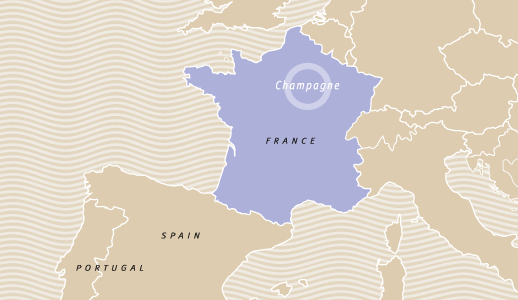
As the holidays approach, sparkling wines come to mind, from inexpensive Proseccos from Italy and Cavas from Spain, to the myriad California and French bubbly to the most famous (and expensive) of all—Champagne (sparkling wine from the Champagne region of  France). Nothing seems to epitomize celebration like Champagne, and when most people consider buying it they look for the large houses such as Moet et Chandon or Veuve Cliquot. These producers source their grapes from all over the region and blend various lots from different areas and even different years to maintain a consistent flavor and style year after year.

There is, however, an interesting alternative—the grower champagnes. The  vineyards sourced by  this type of maker are clustered in a single village and sometimes even a single vineyard. The wines are crafted to reflect the terroir of the village, especially if it is a grand cru vineyard.

Grower Champagnes are usually released younger and often show a lower dosage (the process of adding sugar before final corking) and occasionally no dosage at all. Before shipping, most producers disgorge the deposits that collect in the bottles. The resulting space is filled with a shipping liquor and a tiny bit of pure cane sugar. The absence of dosage allows the intrinsic qualities of the wine, such as terroir and minerality, to show through.

The downside is these wines are more variable year to year compared to the large houses. But the wines are far more interesting and flavorful. Today there are 19,000 growers in Champagne and about 5000 are making their own wines as the popularity grows. To find out if a Champagne is a grower Champagne look for the initials RM (recoltant-manipulant) or ask your wine associate.

While the number of wines is staggering, here are few examples that you can’t go wrong with. Champagne Moutard  is one of my favorite Champagnes period. It is from a grand cuvee vineyard and is 100% Pinot Noir. The wine bursts with brioche, pear, and peach aromas and flavors with beautiful notes of honey, flowers and minerals. The price is about $43.00—not cheap, but on par with Veuve or Moet Chandon NVs, and far more interesting.

Champagne Aubrey is made from a majority of Pinot Meunier with Pinot Noir and Chardonnay as part of the mix. All the fruit is from Grand Cru vineyards. Fresh apples leap from the glass to your nose, with hints of cocoa and toast. There are flavors of passion fruit, apricots and spices, even mango. This wine undergoes malolactic fermentation, giving it impressive body. A beautiful Champagne for $45.00.

Finally there is Jacques Copinet, a NV Champagne that  mimics an aged Vintage Champagne. The aroma is of buttered toast sprinkled with a bit of molasses. On the palate there is a wonderful balance of power, intense caramel breadiness, and wonderful elegance.  Worth the $50.00 you’ll have to spend.

When it’s time to celebrate, try one of these Champagnes and have a truly wonderful experience.

Sunday, September 30, 2012

Forgotten French Grapes – Moved on to “Better” Places?


When customers ask me where the Malbecs are,  I always respond with another question— Argentinian or French?  They look at me quizzically, as though I have no idea what I’m talking about.  I could respond the same way if they asked about Tannat, but no one ever inquires about that wonderful grape.
Many grapes originate in one country but later are found to grow wonderfully in another country and often result in wines completely different from the originals. These wines are fun to compare in “terroir tastings.”

Malbec is an excellent example. This grape originated in Cahors, France and is grown throughout Bordeaux. It’s one of the five grapes that can be blended into the great wines from that region. Wines from Cahors consist mostly of Malbec with a small contribution from another varietal, usually Merlot. These wines are complex, structured with layers of fruit and moderate to fairly big tannins.  Nice examples are Chateau Saint Sernin, Clos La Coutale and Domaine de Cause, all under $20.00. Malbec was later brought to Argentina where it produces massively fruit forward, low tannin wines of medium complexity that are easy drinking, user friendly, and inexpensive. Good examples to try are Durigutti, Renacer Punto Final and  Catena.

Carmenere originated in France and is known as the “forgotten Bordeaux varietal.” It is the sixth grape that is allowed to be blended into Bordeaux, although it has nearly disappeared from that region due to difficulty with ripening. It was brought to Chile, where it prospers. It results in wines with a nose of leather, spice, and chocolate and deep black and blue fruit flavors mixed with spice and pepper. Very nice examples are Odfjell Orzada and Apaltagua.

When the book The Red Wine Diet, which discussed the benefits of red wine on heart health, was published, the author spoke of Tannat, the major grape found in Madiran wines from Southwestern France. Madirans tend to be quite tannic, rustic, and complex. The fiercely tannic Tannat grape is usually blended with Cabernet Sauvignon and/or Cabernet Franc resulting in much softer wines. A great example is 1907, an incredibly complex wine for only $13.00. This grape was brought to South America by Basque immigrants where it has flourished. In fact, it is now the national grape of Uruguay. It also grows well in Argentina. The resulting wine is much more fruit forward and less tannic than Madiran, with lots of dark fruit flavor. A nice is example is made by Rodolfo.

Lots of other grapes move to other places and do well. Grenache originated in Spain and now flourishes in southern France and in Australia, Syrah is everywhere. Zinfandel, known as “America’s grape,” actually originated in Croatia, traveling to America where it is known as Zinfandel, and to Italy where it is known as Primitivo.

So try the same varietal from various parts of the globe. You’ll find out what a difference soil, climate, altitude, and differing winemaking techniques make.  And you’ll no doubt uncover some new favorites!


Wednesday, September 12, 2012

Gruner Veltliner, the Ultimate Food Wine


Our store is located in Boulder, Colorado, a notoriously “foodie” town. We have a huge wine selection and a well-trained wine staff, so we’re often asked about food pairings. Easy, right? Usually, but some foods are difficult.  Asparagus and artichokes, for example, contain a chemical called cynarin which makes wine taste metallic.

Without hesitation, I take customers asking about these two veggies to the Austrian wine section and suggest a Gruner Veltliner (pronounced groon-er velt-leen-er). More often than not, they’ve never heard of it, but if they take my suggestion, it soon becomes one of their “go to” wines.

Gruner Veltliner is grown primarily in Austria where it comprises about 37% of the total grape production. There are two basic expressions of this varietal. If it is grown in the granite soils on the very steep hillsides along the Danube west of Vienna in the areas of Wachau, Kamptal, and Kremstal, the wine is very pure with perfect acidity and enormous minerality—sometimes described as “liquid stone.” These wines are full bodied with beautiful perfumed aromatics and age gracefully. They have the strength of character to match with any food. If the grapes are grown in the southern plains, the perfume is peppery and spicy, and these wines are drunk young.

Berger from Kremstal is crown capped like a beer bottle and comes as a liter only. The wine is light, faintly herbal, and is refreshing like minerally cold spring water. This an excellent entry level Gruner at $15. You’ll be glad it comes as a liter since one glass will not be enough.

Nigl Kremser Freiheit, also from Kremstal, has a smoky, creamy nose that is gradually overtaken by bright fruit and minerals. Light and stimulating, firm and lively, this is a wonderful wine for chicken and artichokes, asparagus soup, or just about any other food.

Arndorfer Weinberge, from Kamptal, is a spicy Gruner with vibrant minerality and acidity, and notes of grass and citrus on the nose. This is a perfect wine to start the evening, as the acidity makes the mouth water and the mind crave food. A great example of this grape’s potential, it’s a bargain for $25.00. Martin Arndorfer, not yet thirty years old, and his wife both come from familes of great winemakers. I had the privilege of meeting this enthusiastic yet humble young man and tasting through a half dozen of his wines, including his Vorgeschmack, 80% Gruner and 20% dry Riesling, aged four months on the lees in 80% stainless steel and 20% used oak. This wine has been one of my staff picks ever since.

Gruner Veltliner is one of the greatest food wines available. The freshness and vibrancy make it especially well suited for cooking that focuses on fresh local ingredients. Chefs all over the world are embracing it.

So next time you head to your wine shop, think Austria!