Showing posts with label Bordeaux. Show all posts

Thursday, November 13, 2014

Meritage—California’s answer to Claret

Bordeaux, France is well known as one of the world’s greatest wine producing regions. The red wines from Bordeaux (known as Claret by the British) are almost all blended wines and can contain one or more of only the following grapes: Cabernet Sauvignon, Cabernet Franc, Merlot, Petit Verdot, Malbec, and Carmenere. Carmenere is rarely used anymore because of difficulty getting it to ripen. It has been introduced to Chile, where it has become that country’s signature red grape.

In 1988, a group of Napa Valley vintners banded together and petitioned the BTFA to allow them to start a brand for a blend that would be considered on par with single varietal wines. The group sponsored a contest to name the brand and 6000 people responded. The winning name was “Meritage”, a cross between “heritage” and “merit.” Although many people try to pronounce it “mer-eh-TAZH”, the proper pronunciation rhymes with “heritage.”

For “Meritage” to be on the label, the wine must have only the allowed Bordeaux grape varietals with no more than 90% being any one varietal, and the winery must be a member of the Meritage Alliance.

There are a great many of these wines on the shelves, and many of them are outstanding. Some are labeled Meritage, some call themselves Claret, and some have names that don’t suggest their blend. They can be very structured and complex, resembling the French wines they are patterned after. They tend to be more fruit forward and less earthy than Bordeaux and are usually less tannic, although the latter characteristic varies widely. They are great wines to have with roasted, grilled, and braised red meats, game, and strongly flavored hard cheeses.

Marietta Cellars, maker of the very popular Old Vine Red, has just released a new wine called Arme’ that is outstanding. Primarily Cabernet with some Merlot, Petit Verdot, and Malbec, this wine has wonderful aromatics of red fruits, mocha, and espresso. There is cassis and red cherry fruit on the palate supported by superbly integrated but ample tannins. This is worth every bit of the $24.99 price tag. The same four grapes are used in Coppola’s Diamond Collection Claret producing wonderful plum, blackberry, anise, and espresso aromas and flavors. Supple tannins make this very approachable, and at $15.99, it is a great bargain.

Newton Claret 2010 is a delicious wine made from Merlot, Cabernet, and Petit Verdot. Aromas of mocha, expresso, and dark red cherries are followed by vanilla, red fruit, and plum on the palate. Supporting tannins add just enough complexity and structure to balance the fruit. 

Finally, Lyeth Merita 2011, made from the all five of the classic Bordeaux grapes, demonstrates aromas of black cherry and currants with subtle notes of dark chocolate. Flavors of cassis and boysenberries are prominent on the palate with a hint of roasted coffee joining on the ample finish. There are supporting but not interfering tannins giving a good backbone to this surprisingly inexpensive wine ($14.99).

It is possible to enjoy the structure and complexity of Cabernet based blends without heading for the Bordeaux section, especially if one prefers the bigger fruit of New world wines to the mineral driven, less fruit forward style of old world wines.

Wednesday, December 18, 2013

An Afternoon in France With Dion Jones-Lewin - Great Food, Wine…and a bit of Good Whisky Too

On Saturday, December 14th, we had the pleasure of hosting Dion Jones-Lewin at our store. She signed her cookbooks and handed out samples of delicious French fare as I poured some wonderful French wines and an excellent French Whisky to celebrate.

This delightful lady was born and raised in Paris and learned to cook from her Grand-mere. After her grandmother’s death, Dion found a sealed box filled with recipes and family photos, which inspired her to write her series of cookbooks, “From the Sealed Box: Simply French”. They are written to allow anyone to experience French cuisine without spending hours in the kitchen.

Dion charmed our customers, introducing them to the joys of French cooking - and sold a lot of cookbooks. This was not surprising as her books are very well written with easy to read and follow recipes…and lists of ingredients which are not impossible to find. There are four volumes in the series, with her recently released “A French Christmas” now available. You can find out more about Dion and her Cookbooks at  CafeDion.com.

We poured four wines to celebrate France. They all showed well and many people enjoyed them enough to purchase the wine from a bottle or two to a case or so.

Domain du Salvard Cheverney Blanc 2012. This is a blend of 85% Sauvignon Blanc and 15% Chardonnay from estate vineyards in Cheverney, a small appellation  in the Loire Valley. It is fresh and crisp with flavors of citrus, mineral and a generous acidity that results in a mouth watering finish that is refreshing and food friendly. It is a good alternative to the more pricey Sancerre produced nearby, costing only $14.99 per bottle.

Champalou Vouvray Sec 2011.  This wine is 100% Chenin Blanc and is from an estate founded by Didier and Catherine Champalou in the early 1980’s. White acacia flowers, honey  and citrus on the nose and a complex flavor profile of citrus  fruits with a beautiful minerality  make this a wonderful food wine. Priced at 21.99.

Clos la Coutale Cahors 2011. When Malbec is mentioned, people think of Argentina although Cahors, located just south of Bordeaux, is the birthplace of this grape. It was taken to Argentina by French emigrants at the end of the nineteenth century and has become that country’s signature red varietal. This wine which is 80% Malbec and 20% Merlot is much meatier, earthier and more structured than the Argentinan style of Malbec. It has a similar fruit profile but  is less flashy and fruit driven and  is an outstanding wine. $19.99.

Chateau Aney Haut- Medoc Rouge 2010. This Bordeaux blend from the Left Bank is a great value from an area where wine prices can get astronomical. Left Bank wines are usually Cabernet Sauvignon  predominant, and this is indeed primarily Cabernet, tempered and rounded with a bit of Merlot, Malbec and Petit Verdot. It is aged 12 months in new French oak. There is a nose of cassis, black fruits, graphite and tobacco with a wonderful fruit and earth flavor profile.  Delicious now and will only get better in the cellar for the next several years. A bargain at $32.99.

Last but not least, we poured a wonderful Whisky, Bastille. When thinking of Whisky, nobody thinks of France – at least until they try this. It is distilled from barley and wheat and is aged primarily in French Limousin oak for five to seven years. It has a floral, fruity nose with a hint of cinnamon. On the palate, it is slightly sweet and honeyed, with a bit of clove, cinnamon and nutmeg. This is a beautiful whisky that is  best enjoyed neat and is a bargain at $30.00.

Dion’s cookbooks combined with her delightful personality, great wines being poured, a few morsels demonstrating her expertise…topped off with a sip of a great whisky…make my job very easy to enjoy.

Cheers!

Saturday, November 2, 2013

Some Great Bargains From a Small Distributor

One of the biggest concerns of customers in our store is the price of wine. Many people come in after a trip to France or Italy and are discouraged by the fact that they see $19.99 price tags on wines they drank in Europe for a few Euros. This is not because we are making huge margins at Liquormart, and it certainly isn't the fact that the winemakers are getting paid any premiums for shipping their wines here. The reason is the multi-tiered system that rules the wine industry. An estate in Europe must sell its wine to an importer. That importer then sells it to a distributor, who sells it to the store. Often the estate has to pay a negociant to make the wine available to importers.  With everybody getting their substantial cut, it is small wonder that the wines double or even triple in price from the estate to the shelf.

Is there a way to combat this? Not always, but one person does it the right way. Enter Denver's own Philippe Sevier.  He owns some vineyards of his own in Europe. He also visits other small estates that make wonderful  wines, and brings them to Colorado, acting as importer AND distributor. He even delivers the wines himself in his van. When other distributors host trade tastings they do so at restaurants, museums or art galleries at considerable expense (ultimately born by the customer in the store). Phillipe hosts trade tastings in his dining room, with dozens of wines lined up on the table, a few assorted cheeses to enhance the flavors of the wine, and an occasional treat from his delightful wife's oven.  He knows everything about every wine, so it is a very valuable experience for all who attend.

Not only do his methods keep prices very reasonable, but he gives small estates an opportunity to showcase their wines...and many of these wines are very, very good. They grow grapes in the same terroir as the more expensive, well known estates, and have similar winemaking techniques. They can avoid the techniques of mass production that enable the production of hundreds of thousands of cases of wine, and also diminish the flavor and character. The result is a great wine for a great price.

Sampling Sevier's wines is like taking a tour of Europe, and it doesn't feel like a low budget one either, until you hit the checkout line. If we start in Bordeaux, chateau Carbonneau delivers vibrant black fruit flavors with earth, cassis and spice. This is an every day dinner wine for $9.99. Chateau La Croix Bonnelle from St Emilion, shows surprising complexity, with rich dark fruit, earth and spice. One of the most expensive wines in his portfolio at a whopping $16.99!

When looking for crisp, minerally vibrant whites, one may forget Bordeaux and Sevier is there to remind you of these great bargains.

These wines are blends of Sauvignon Blanc and Semillon, are beautiful food wines, and perfect for large events....and I sell a lot of this wines for wedding receptions. Chateau Vrai Caillou and Chateau Des Chapelains, both at $9.99, give a mouthful of mineral driven, fresh, vibrant tropical and citrus fruit.
 
Traveling next to Cahors, we come to the birthplace of Malbec. Although most people think of Argentina when they think of this grape, it originated in France and is one of the grapes found in red Bordeaux. Cahors are primarily Malbec with a little Merlot or Tannat thrown in. They are more structured and less fruit forward than the typical Argentinian example, and more complex. Sevier has two, and they are excellent – Chateau St Sernin ($13.99) and  and Chateau Nozieres ($12.99), both are bursting with ripe plumb, black cherry, cocoa, vanilla and spice. Next time when you think of Malbec, give one of these a try.

Looking for a different summertime white? Think Ugni Blanc, a grape most famous for its use in Cognac. In the Cotes du Gascogne, in southern France, this grape makes very flavorful whites. Domain D'Uby makes a blend of Ugni blanc and Columbard. It is fresh and vibrant, similar to a Sauvignon Blanc, but a little more floral and nutty. Awesome at the massive price of $8.99. do you HAVE to have your weekly Chardonnay fix? The Philippe Sevier Chardonnay from the Loire valley, in an unoaked style gives the best mothful of tropical and citrus fruit you'll ever have for a $8.99 price tag.

This is just a small sample of Mr. Sevier's  list of wines. Burgundy is represented and he really does the Loire Valley in style. Wines from Chinon, Bougeuil, Anjou, Muscadet, Sancerre and Vouvray are all found on our shelves and are all fun to try, with not a single one over 15.99!!! The Rhone Valley is not forgotten either. So come in the store and ask for me. Let Philippe Sevier and I take you on a tour of France. First class accommodations at Supersaver prices.

Cheers!

Tuesday, March 5, 2013

Red Bordeaux—Expensive and Confusing?
Nope… Hints to “Bank” On


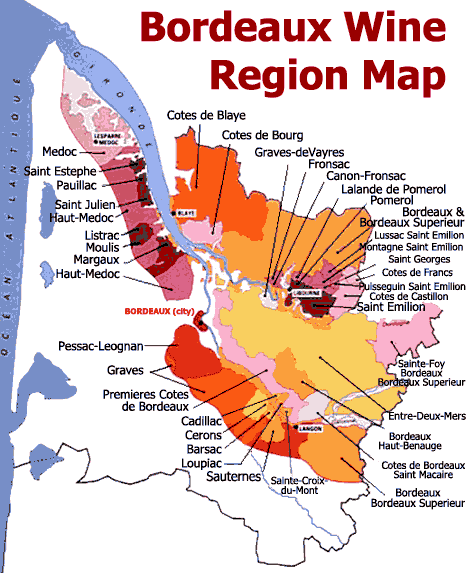
Customers are afraid of the Bordeaux section because first, they figure it will be expensive, and second, they don’t understand what they are reading on the label. Have no fear. Simply put, a red Bordeaux wine is a wine produced in the Bordeaux region of France. It is the largest French wine producing area, composed of over 120,000 hectares of vineyards and producing over 700 million bottles of wine each year.

The region’s hub is the city of Bordeaux, which sits on the west bank of the Gironde River and runs from southeast to northwest on its course to the Atlantic Ocean in west central France. Just north of Bordeaux, the Dordogne River empties into the Gironde from the southeast, forming a “Y”. The Estates along the western bank of the Gironde are known as “Left Bank” and those along the east bank of the Dordogne are known as “Right Bank.” The area between the two arms of the “Y” is known as “Entre Deux Mers” (“between two seas.”)

Why do we care about all this? Here's why:

By law, only six grapes that can be included in red wines from Bordeaux—Cabernet Sauvignon, Merlot, Cabernet Franc, Malbec, Petit Verdot, and Carmenere. The first two are by far the largest contributors. The climate and the soils are vastly different on the Left and Right Banks—so much so that Cabernet Sauvignon grows far better on the Left Bank, and Merlot and Cabernet Franc far better on the Right Bank and in Entre Deux Mers. Consequently, Left Bank wines are Cabernet predominant and therefore more tannic, structured, and long lived as a rule (and less approachable at an early age.) The wines from the Right Bank are Merlot driven, with Cabernet Franc as an important component and much less Cabernet Sauvignon. Right Bank Bordeaux tends to have lusher fruit, somewhat softer tannins, and can be enjoyed at an earlier age. So when you come to the store, you’ll know which “Bank” of Bordeaux you prefer.

If only the label on the wine said “Left” or “Right” Bank, the world would be perfect, but that would be too easy. Instead, the label will usually indicate the appellation, and you should leave it up to your wine geek to know that Medoc, Haut Medoc, Margaux, St. Estephe, Graves, and St. Julian are all Left Bank, and Pomerol, St Emillion, and Canon-Fronsac are Right Bank. As long as you know what style you like, you will get a wine you love.

In 1855, Napolean III requested that Bordeaux wines be classified into five levels, or growths, according to the amount of money they commanded. Four first growths were named—Lafite Rothschild, Margaux, Haut Brion, and Latour. In 1973, Mouton Rothschild was added. All five of these wines are from the Left Bank and cost upwards of $1000.00 per bottle upon release. Even fifth growths which fifteen years ago could be purchased for $30.00-$45.00 now cost over $100.00. Although the Right Bank wines aren’t in this classification, Chateau Cheval Blanc, Chateau Petrus, and Chateau le Pin are still in these price ranges.

Because of these crazy prices, most of us will never get a chance to try these wines, which fuels the idea that Bordeaux is only for the rich. This is not true. Although the first through fifth growths are the most famous fifty or so wines from the Left Bank, and about twenty similar wines exist from the other side, over 8400 other Bordeaux producers remain. These “petits chateaux” produce very nice wines for $40.00, $25.00, and even $15.00. These wines express the terroir and varietal character of the appellation where they are grown and are pleasant to drink often upon the day of bottling. They don’t age like the classified growths but will improve over three or four years.

Bordeaux wines as a rule are made from rather tannic grapes and they are aged in oak, so they’re going to be tannic. Don’t look to these wines for sipping at a cocktail party or drinking on their own by the fire one evening. These are food wines. They have aromatics and flavors of red and black fruit, with solid structure and good acidity. They tend to be a bit lower in alcohol than their California counterparts. These characteristics are typical of the cooler climate in Bordeaux. Because the climate is cool, year to year variance can be marked. Time of last frost, daily temperatures, and amount and time of rainfall all have a huge influence on the quality of wine in a given year. Be sure to ask your wine specialist which vintages to avoid or look for, or which are best for drinking early or putting away for a few years.

So tonight you are having a dinner of beef, lamb, or game. Bordeaux is an excellent choice. If you want to splurge a bit and like the structure of Cab based wines, the Chateau Mongravey (Margaux) is outstanding for $44.99. The Right Bank and Merlot predominant L’Excellence des Menuts at $42.99 is drinking perfectly.

Want to spend less and still drink well? From the Left Bank we have the Chateau Le Pey (Medoc, $16.49) and Chateau Beauregard Lagupeau (Graves, $16.99), and from the Right we have La Croix Bonnelle (St. Emillion, $16.99) and La Croix Meunier (St. Emillion, $24.99). These are all nice examples of Bordeaux at reasonable prices. There are others in the $10.00-12.00 range that will amaze you.

Bordeaux doesn’t have to be complicated and it certainly doesn’t have to be expensive. Wines from this area have been among the most renowned in the world for hundreds of years. It’s time you found out what all the fuss is about. You will be glad you did.

You can “bank” on it!

Sunday, September 30, 2012

Forgotten French Grapes – Moved on to “Better” Places?


When customers ask me where the Malbecs are,  I always respond with another question— Argentinian or French?  They look at me quizzically, as though I have no idea what I’m talking about.  I could respond the same way if they asked about Tannat, but no one ever inquires about that wonderful grape.
Many grapes originate in one country but later are found to grow wonderfully in another country and often result in wines completely different from the originals. These wines are fun to compare in “terroir tastings.”

Malbec is an excellent example. This grape originated in Cahors, France and is grown throughout Bordeaux. It’s one of the five grapes that can be blended into the great wines from that region. Wines from Cahors consist mostly of Malbec with a small contribution from another varietal, usually Merlot. These wines are complex, structured with layers of fruit and moderate to fairly big tannins.  Nice examples are Chateau Saint Sernin, Clos La Coutale and Domaine de Cause, all under $20.00. Malbec was later brought to Argentina where it produces massively fruit forward, low tannin wines of medium complexity that are easy drinking, user friendly, and inexpensive. Good examples to try are Durigutti, Renacer Punto Final and  Catena.

Carmenere originated in France and is known as the “forgotten Bordeaux varietal.” It is the sixth grape that is allowed to be blended into Bordeaux, although it has nearly disappeared from that region due to difficulty with ripening. It was brought to Chile, where it prospers. It results in wines with a nose of leather, spice, and chocolate and deep black and blue fruit flavors mixed with spice and pepper. Very nice examples are Odfjell Orzada and Apaltagua.

When the book The Red Wine Diet, which discussed the benefits of red wine on heart health, was published, the author spoke of Tannat, the major grape found in Madiran wines from Southwestern France. Madirans tend to be quite tannic, rustic, and complex. The fiercely tannic Tannat grape is usually blended with Cabernet Sauvignon and/or Cabernet Franc resulting in much softer wines. A great example is 1907, an incredibly complex wine for only $13.00. This grape was brought to South America by Basque immigrants where it has flourished. In fact, it is now the national grape of Uruguay. It also grows well in Argentina. The resulting wine is much more fruit forward and less tannic than Madiran, with lots of dark fruit flavor. A nice is example is made by Rodolfo.

Lots of other grapes move to other places and do well. Grenache originated in Spain and now flourishes in southern France and in Australia, Syrah is everywhere. Zinfandel, known as “America’s grape,” actually originated in Croatia, traveling to America where it is known as Zinfandel, and to Italy where it is known as Primitivo.

So try the same varietal from various parts of the globe. You’ll find out what a difference soil, climate, altitude, and differing winemaking techniques make.  And you’ll no doubt uncover some new favorites!