Showing posts with label red wine. Show all posts

Wednesday, December 3, 2014

Nebbiolo—Italy’s Noble (and finicky) Grape

Most people who know me at the store will attest to my love of Italian wines. So it was inevitable that I’d write about Italy’s noblest of grapes, Nebbiolo. It is essentially found only in the region of Piedmont, in northwestern Italy at the foot of the Alps, and is grown almost nowhere else in Italy or in the world for that matter—only a few small and relatively unsuccessful attempts in the U.S, Australia, South America, and Mexico. That is because the region’s unique continental climate tempered by the Tanaro River combined with the soil type cannot be replicated anywhere else.

Nebbiolo is derived from nebbia, which is Piedmontese for the fog that envelopes the region during harvest in October. It dates back to the fourteenth century, and plantings in the region increased until around 1860, when phylloxera wiped many vineyards. Many were replanted with other varietals, especially Barbera. Nebbiolo is the first grape in the region to bud and the last to ripen, being harvested in mid to late October, long after the more prevalent Dolcetto and Barbera. It needs to be planted on south and southwestern facing slopes at an altitude of 820 to 1500 feet. It is susceptible to coulure (failure to form fruit after flowering), is genetically unstable with frequent mutations, and is very sensitive to soil type. It is so difficult to grow that only about 3% of Piedmont’s (and therefore, the world’s) production consists of Nebbiolo wines.

So why bother with such a temperamental grape? Because the WINES…oh my God, the wines! The wines produced, especially those from the tiny DOCGs of Barolo and Barbaresco, begin as lightly colored, very tannic, highly acidic wines with characteristic aromatics of roses and tar. After proper aging (and some of these wines require ten years and many improve over forty years), they transform into majestic, complex wines, intensely aromatic with notes of tar, roses, violets cherries, tobacco, herbs, and raspberries on the nose and palate. The characteristic almost brick–orange color and medium body belies the complexity and power that sits in the glass before you. These wines are among the most extraordinary in the world.

Nebbiolo wines are made with traditional or more modern methods, resulting in very different wines. The traditional methods include long maceration (20 to 30 days) and maturation in older large barrels. Modern methods include shorter maceration at cooler temperatures and aging in small new oak barrels, resulting in wines that are more approachable earlier. Many producers are now combining the techniques with good success.

Nebbiolo wines are produced mainly in the Lange appellation of Piedmont, and the most famous come from the vineyards surrounding the small towns of Babaresco and Barolo. Barbarescos are a bit lighter and more elegant of the two, and DOCG rules require that they are aged in oak at least nine months and a total of at least twenty-one for ormale wines and forty-five for Riservas. Barolos are more powerful and require one year of oak aging and at least thirty-six months total aging for the normale and a whopping fifty-seven months for the Riservas. With the tiny amount of plantings and the fact that a producer’s wines may not be sold until up to almost five years after vinifying them, it’s small wonder that they are so pricey on the shelf. Consequently, it’s hard to find a decent Barolo or Barbaresco for under $35.00, and you are more likely to pay over $50.00 or $60.00. Some of the great producers command hundreds of dollars for their wines, and they still sell out quickly.

We have lots of great Barolos in the store. Brovia is a great one, with the entry level 2010 selling for $51.99. However the otherworldy Brovia Rocche 2008, rated 96 points by Critic Robert Parker, will cost you $94.99. The Ceretto 2010 DOCG Barolo 2010 and Barbaresco 2011 are wonderful to taste side by side at 59.99 each. The Vietti Barolo 2010 Castiglione is wonderful at $52.99. Finally, if you want to taste what a Barolo or Barbaresco tastes like without breaking the bank, Natale Verga makes very good, if not world class, examples for $27.99 and $24.99.

Nebbiolo wines are being made from younger vines and vinified by more modern techniques. They are very approachable young and are delicious (and much more affordable), often being a bit bigger in fruit than the more traditional wines and they are delicious! Eugenio Bocchino’s Roccabella Nebbiolo 2012 is fantastic at $20.99. Vietti Perbacco 2011 at $25.99 is worth every penny. Rivetto makes a nice lighter version for $18.99.

If you want to venture outside of Langhe to the far northern reaches of Piedmont, the areas of Gheme and Gattinara make wonderful Nebbiolo wines that are a bit lighter and earthier. Travaglini Gattinara is awesome at $33.99.

While Nebbiolo wines are not cheap, they are incredibly good. Anyone truly interested in experiencing the best the wine world has to offer needs to try them. Cheers!

Thursday, November 13, 2014

Meritage—California’s answer to Claret

Bordeaux, France is well known as one of the world’s greatest wine producing regions. The red wines from Bordeaux (known as Claret by the British) are almost all blended wines and can contain one or more of only the following grapes: Cabernet Sauvignon, Cabernet Franc, Merlot, Petit Verdot, Malbec, and Carmenere. Carmenere is rarely used anymore because of difficulty getting it to ripen. It has been introduced to Chile, where it has become that country’s signature red grape.

In 1988, a group of Napa Valley vintners banded together and petitioned the BTFA to allow them to start a brand for a blend that would be considered on par with single varietal wines. The group sponsored a contest to name the brand and 6000 people responded. The winning name was “Meritage”, a cross between “heritage” and “merit.” Although many people try to pronounce it “mer-eh-TAZH”, the proper pronunciation rhymes with “heritage.”

For “Meritage” to be on the label, the wine must have only the allowed Bordeaux grape varietals with no more than 90% being any one varietal, and the winery must be a member of the Meritage Alliance.

There are a great many of these wines on the shelves, and many of them are outstanding. Some are labeled Meritage, some call themselves Claret, and some have names that don’t suggest their blend. They can be very structured and complex, resembling the French wines they are patterned after. They tend to be more fruit forward and less earthy than Bordeaux and are usually less tannic, although the latter characteristic varies widely. They are great wines to have with roasted, grilled, and braised red meats, game, and strongly flavored hard cheeses.

Marietta Cellars, maker of the very popular Old Vine Red, has just released a new wine called Arme’ that is outstanding. Primarily Cabernet with some Merlot, Petit Verdot, and Malbec, this wine has wonderful aromatics of red fruits, mocha, and espresso. There is cassis and red cherry fruit on the palate supported by superbly integrated but ample tannins. This is worth every bit of the $24.99 price tag. The same four grapes are used in Coppola’s Diamond Collection Claret producing wonderful plum, blackberry, anise, and espresso aromas and flavors. Supple tannins make this very approachable, and at $15.99, it is a great bargain.

Newton Claret 2010 is a delicious wine made from Merlot, Cabernet, and Petit Verdot. Aromas of mocha, expresso, and dark red cherries are followed by vanilla, red fruit, and plum on the palate. Supporting tannins add just enough complexity and structure to balance the fruit. 

Finally, Lyeth Merita 2011, made from the all five of the classic Bordeaux grapes, demonstrates aromas of black cherry and currants with subtle notes of dark chocolate. Flavors of cassis and boysenberries are prominent on the palate with a hint of roasted coffee joining on the ample finish. There are supporting but not interfering tannins giving a good backbone to this surprisingly inexpensive wine ($14.99).

It is possible to enjoy the structure and complexity of Cabernet based blends without heading for the Bordeaux section, especially if one prefers the bigger fruit of New world wines to the mineral driven, less fruit forward style of old world wines.

Thursday, October 30, 2014

Barbera—The Ultimate Food Wine

A good red wine to match with food must have enough flavor to stand up to what you are eating but not so much to overpower it. If the food has a high fat content, such as a nicely marbled ribeye steak, the wine should have ample tannins to cut through the fat, but in the absence of fat, tannins should be moderate to low. Perhaps the most important trait of a food friendly red is ample acidity. This keeps the wine refreshing, vibrant, and palate cleansing and enhances the flavors of the meal.

With this in mind, one of my favorite wines to recommend is Barbera. Native to the Monferrato region near the town of Asti in Piedmont, Italy, where it has been documented as far back as 1240 in the records of the local cathedral, it is the third most planted red grape in Italy behind Sangiovese and Montepulciano. Although over 70,000 acres grow in Piedmont,  and it was a favorite of Italian immigrants resulting in 8000 acres growing in California, it is surprising how few people know about it.

In the early 1980s, over 120,000 acres of Barbera were planted in Piedmont. Then, in 1985, unscrupulous producers added methanol to their wine to give it a little extra “kick.” As a result, 30 people died and over 50 were blinded. This bad publicity along with growers switching to more profitable Nebbiolo led to a marked decrease in production.

Barbera grows best in warm climates and tends toward high yields, so it must be aggressively pruned. It is very thin skinned, so it is prone to mildew, disease, and sunburn. It ripens two weeks earlier than Nebbiolo and two weeks later than Dolcetto, the other two major Piedmont grapes. The grape has a very high acidity, approaching that of white wine grapes. Leaving the fruit on the vine longer to lessen the acidity results in higher sugar levels, denser flavors, and a higher alcohol level in the finished wine. When this balancing act between acidity and fruit concentration is performed well, the wine is delicious.

Barbera is dark in color, has medium to low tannins, a high acidity, and flavors of red fruit and black cherries There are two styles—a lighter style that is usually made without oak aging, and a richer more complex style that is aged in used oak. They are both delicious and are wonderful with food, from pasta with red sauce, sausages, and pork to stews and braised and roasted meats. In Italy, the spicy fruity Dolcetto is the everyday and (ALL day) drinking wine, while the Barbera is the wine enjoyed with the main meal. (The higher priced Nebbiolo is for special occasions).

Besides being delicious and food friendly, really good Barbera can be found in the 15 to 25 dollar range. Mauro Molino Barbera d’Alba, aged in stainless steel, is fresh and vibrant with a mouth watering acidity and lots of red berry fruit and costs only $15.99. Rivetto Barbera d’Alba Nemes, also $15.99, is aged for a short time in Slovenian oak but retains its freshness and lightness of fruit.

If you are going to try Barbera, you absolutely HAVE  to try the Barbera di Monferrato from Fabrizio Iuli. He calls himself a “Barberista” because although most Piedmont estates that make Barbera also make Nebbiolos and Dolcettos, he concentrates only on Barbera. His Umberta, at $15.99, is aged in stainless steel and is an explosion of exuberant red berry fruit fruit in your mouth. The Rossore (named because that will be the color of your cheeks when you drink it) is aged in French oak and is lush and complex with the underlying acidity and ample red and purple fruit that is classic for Barbera, This is one of my very favorite wines with Italian food and is well worth the $22.99 price tag.

Natale Verga makes a very drinkable Barbera for only $8.99.  Although not world class, it is varietally correct, and a good way to find out if you like this grape without spending much money.

Finally, at the other end of the spectrum, if you want to taste what is probably the ultimate expression of the Barbera grape, try G.D. Vajra’s Barbera d’Alba Superiore. I first tasted this wine at a large trade tasting a year ago featuring at least a hundred wines including some very expensive Barolos and Barbarescos. Vajra’s Barbera was THE wine of the tasting. With beautiful aromatics of flowers, red and purple fruit, and massive complex layers of black cherry, plums, red currants, and vanilla, it has a bracing acidity that makes your mouth water and makes you want to consume the entire bottle with a very large amount of food. In a word, this wine is ridiculous. It will be $44.99 well spent.

Barbera is a wine that anybody who loves a good meal needs to try. It will bring even the simplest of dishes to life…and it will become a common occurrence at the dinner table. Cheers!

Monday, October 13, 2014

Looking For a Few Good Men—Sardinia’s New Winemakers

Sardinia is Italy’s second largest island and lies about 150 miles off the western coast. Interestingly, the island not only is isolated in terms of geography, but also regarding grape varietals. Instead of finding typical Italian red grapes like Sangiovese,  Nebbiolo, or Negroamaro, we find those commonly associated with France and Spain—Grenache, Carignan, and Bobal.  The whites have a little more Italian feel, with Malvasia and Vermentino being dominant, as well as the ubiquitous Muscato Bianco. There are as well some indigenous grapes, like Monica, Torbato, and Nasco, and a host of others.

The Italians’ love of complex bureaucracy is evident in the fact that there are more D.O.C. and I.G.T designations than in nearby Calabria and Basilicata combined despite there being fewer vines per overall hectare than any other wine region in Italy.

Unfortunately, despite the climate and soil being ideal for grape growing, this is a rare part of Italy where the growing of wine grapes is not a priority.

In the sixteenth century, Sardinia was abundant with vineyards, to the point that it was called the “Wine Island,” but then the number of vineyards declined until the beginning of the twentieth century. At that time, several cooperatives arose and bought grapes on a guaranteed price per volume.  As a result, high yields were prized far above quality, and Sardinia became known for producing cheap low quality “plonk” wines.

In the early 1990’s a few serious winemakers decided to change the face of Sardinian wines. They improved vineyard management, and soon yields were low and qualities were high. They brought in new winemaking techniques and combined the best of these with the best of traditional methods to ensure that the “terroir” would be preserved in the wines.

While few Sardinian wines actually get to the U.S., three estates send enough wine across the ocean to be found at very good prices. First is Sella and Mosca’s Canonnau di Sardegna Riserva. Cannonau is the Sardinian word for Grenache, and this is one of the finest wines made from that varietal that you’ll ever find. Aromas of violets, bright red berries, and jam. On the medium bodied palate, there are spices and herbs beneath the ample red fruit. Medium bodied with supple tannins, this wine was once called the world’s best wine under $25.00 by Robert Parker. It is considerably less than that—a steal at $16.99.

Argiolas makes a bevy of wonderful wines. They make a Cannonau as well, called Costera, that is of similar flavor profile and quality as the Sella and Mosca—and a similar price as well. The Perdera is made from the indigenous Monica grape, and shows more blue and black fruit on the palate than Grenache and is delicious.

Finally, there is a wonderful Vermentino called Costamolino. Full of bright citrus and tropical fruit with a nice underlying mineralty, this is an outstanding food wine.

Last and certainly not least is the Santadi Carignano del Sulcis Grotto Rosso. This wine bursts with savory dark fruit, leather, and earth and is an awesome wine to have with your next beef stew. I love this wine, and at $14.99, it is an awesome value.

Italy is one of the greatest wine regions on earth. There are hundreds upon hundreds of different varietals made into wine. Each of the many regions has its own expression of its wines, and Sardinia is no different. Try them, and you’ll be very happy that you did. Cheers!

Wednesday, December 18, 2013

An Afternoon in France With Dion Jones-Lewin - Great Food, Wine…and a bit of Good Whisky Too

On Saturday, December 14th, we had the pleasure of hosting Dion Jones-Lewin at our store. She signed her cookbooks and handed out samples of delicious French fare as I poured some wonderful French wines and an excellent French Whisky to celebrate.

This delightful lady was born and raised in Paris and learned to cook from her Grand-mere. After her grandmother’s death, Dion found a sealed box filled with recipes and family photos, which inspired her to write her series of cookbooks, “From the Sealed Box: Simply French”. They are written to allow anyone to experience French cuisine without spending hours in the kitchen.

Dion charmed our customers, introducing them to the joys of French cooking - and sold a lot of cookbooks. This was not surprising as her books are very well written with easy to read and follow recipes…and lists of ingredients which are not impossible to find. There are four volumes in the series, with her recently released “A French Christmas” now available. You can find out more about Dion and her Cookbooks at  CafeDion.com.

We poured four wines to celebrate France. They all showed well and many people enjoyed them enough to purchase the wine from a bottle or two to a case or so.

Domain du Salvard Cheverney Blanc 2012. This is a blend of 85% Sauvignon Blanc and 15% Chardonnay from estate vineyards in Cheverney, a small appellation  in the Loire Valley. It is fresh and crisp with flavors of citrus, mineral and a generous acidity that results in a mouth watering finish that is refreshing and food friendly. It is a good alternative to the more pricey Sancerre produced nearby, costing only $14.99 per bottle.

Champalou Vouvray Sec 2011.  This wine is 100% Chenin Blanc and is from an estate founded by Didier and Catherine Champalou in the early 1980’s. White acacia flowers, honey  and citrus on the nose and a complex flavor profile of citrus  fruits with a beautiful minerality  make this a wonderful food wine. Priced at 21.99.

Clos la Coutale Cahors 2011. When Malbec is mentioned, people think of Argentina although Cahors, located just south of Bordeaux, is the birthplace of this grape. It was taken to Argentina by French emigrants at the end of the nineteenth century and has become that country’s signature red varietal. This wine which is 80% Malbec and 20% Merlot is much meatier, earthier and more structured than the Argentinan style of Malbec. It has a similar fruit profile but  is less flashy and fruit driven and  is an outstanding wine. $19.99.

Chateau Aney Haut- Medoc Rouge 2010. This Bordeaux blend from the Left Bank is a great value from an area where wine prices can get astronomical. Left Bank wines are usually Cabernet Sauvignon  predominant, and this is indeed primarily Cabernet, tempered and rounded with a bit of Merlot, Malbec and Petit Verdot. It is aged 12 months in new French oak. There is a nose of cassis, black fruits, graphite and tobacco with a wonderful fruit and earth flavor profile.  Delicious now and will only get better in the cellar for the next several years. A bargain at $32.99.

Last but not least, we poured a wonderful Whisky, Bastille. When thinking of Whisky, nobody thinks of France – at least until they try this. It is distilled from barley and wheat and is aged primarily in French Limousin oak for five to seven years. It has a floral, fruity nose with a hint of cinnamon. On the palate, it is slightly sweet and honeyed, with a bit of clove, cinnamon and nutmeg. This is a beautiful whisky that is  best enjoyed neat and is a bargain at $30.00.

Dion’s cookbooks combined with her delightful personality, great wines being poured, a few morsels demonstrating her expertise…topped off with a sip of a great whisky…make my job very easy to enjoy.

Cheers!

Friday, December 13, 2013

Tired of the same old varietals? Me Too!

People who know me have often asked why I can claim so many previous occupations. I tell them either that I get bored easily, or that I can’t decide what I want to do when I grow up. I guess both of these are true which has led to me to be an obstetrician/gynecologist for 20 years, own an equestrian training/breeding facility, be a bartender and kayak guide in the Caribbean, and eventually end up in the next logical thing…retail wine and wine education.

My restlessness extends to other aspects of my life, including the wines I drink. I can only drink so much Merlot and Cabernet without wanting to venture into the vast world of different grapes that become incredible wines. So let’s look at some fun wines to impress your dinner guests with. Italy, with over 1000 grapes that have been, or are being, made into wine, is a great place to start.

San Giovanni Il Groppello. Groppello is the major grape grown in the Lago Garda area between Veneto and Lombardy. When you open the squat little bottle aromas of dark cherries and spice leap from within. The wine is medium bodied and silky with moderate tannins supporting minerally dark fruit flavors. It is a delicious alternative to Pinot Noir for $22.99.

Emilio Bulfon in Friuli has dedicated his life to resurrecting obscure grapes that often were thought to be extinct. His Forgiarin is an excellent example. The wine is medium to full in body with fruity aromas with hints of underbrush. On the palate warm, smooth flavors of red fruit are supported by light supple tannins. A bit understated but plenty of flavor to enjoy and wonderful with pork or fowl. $19.99.

Castelfeder Rieder Lagrein. Lagrein is a grape native to Alto Adige, in the far north of Italy where more Germen is spoken than Italian. This wine has aromatics of black and red cherries with a hint of violets. Medium to full in body, it is intense but soft textured, chewy but not heavy. Your palate will experience earthy plums and dark cherries with a pronounced mineral edge and a wonderful savoriness. My favorite wine with beef stew. $19.99.

We could stay in Italy for the rest of this article and talk about Piculit Neri, Teroldego, or Nerello Mascalese but we should head elsewhere. Before we do, we should touch on a white wine, and Arianna Occhipinti’s SP68 would be my choice. This young rock star winemaker from Sicily is crafting wines from indigenous varietals such as Frapatto, Grillo and Nero D’Avola. But this white, made from Albanella and Zibibbo is off the charts. Bright and fresh, with bold zesty flavors of citrus, white peach, and tropical fruit with a rosemary-ginger kick at the back end. Pricey at $29.99, but fabulous!

France has its share of grapes you never heard of, too. For a great bargain in white wine, try Saint Mont “Les Bastions”. From the Basque country of Southwest France, this fresh, vibrant, delightful wine is a blend of Gros Manseng, Petit Courbu and Arrufiac. There are floral and citrus-grapefruit aromas with grapefruit and herbs on the palate. With a bracing acidity it is a great little wine on its own or with food for $10.99.

Jura is a little known region of France which is currently a darling of high end restaurants and sommeliers. Jacques Puffeney’s Arbois is a wonderful wine made from the Trousseau Noir grape. Known as the “Pope of Jura” he brings the best out of this grape. The nose is of wild berries, game, and pine. There are mineral infused flavors of red cherries and berries with grainy tannins. There is a wonderful rustic quality that makes this a unique wine. It is not cheap, at $42.99, but worth the experience.

Domain de Labarthe Gaillac is from the region of Gaillac in Sothwestern France and is a blend of Fer-Servado, Braucol and Duras. Flavors and aromas of dried herbs, red fruit, pencil lead and minerals in this earthy, rustic wine end with a spiced, tart smoky finish. Unusual and delicious at $20.99.

No discussion on unusual grape varietals would be complete without an entry from Greece. Domain Skouras makes a wonderful red from the Aghiorghitiko (honest) grape. Since the grape is so hard to pronounce it has been renamed Saint George for English speaking wine lovers.  Big lush flavors of dark fruit in this complex earthy wine make for a delightful pairing with lamb or braised meats. At $14.99 it’s a great way to forget that Greece has to claim Retsina as coming from there.

These are just a few of the unknown, unusual and wonderful varietals out there to explore. There are many more and they are worth every effort to find. Think how smart you’ll sound when you matter of factly say “Here’s a delightful little Garganega I picked up recently…”

Cheers! 

Monday, December 2, 2013

Beaujolais – More Than A November Celebration

When the third Thursday of November rolls around every year, the light, fruity red wine known as Beaujolais Nouveau appears all over the world to celebrate the French harvest.  Meant to be drunk the first few months after its release and made from grapes that were literally hanging on the vine 8 weeks earlier, the wine has become popular largely through great marketing techniques. With aromatics of strawberry and bubble gum and flavors of strawberry, banana and pear, it is hardly a serious wine and has in fact, had a negative effect on the reputation of serious winemakers from the appellation of Beaujolais.

Beaujolais is found in the region stretching from southern Burgundy to the northern Rhone. It is considered part of Burgundy, but the terroire is closer to that of the Rhone. Beaujolais is made from the Gamay grape, an offspring of the cross between Pinot noir and an ancient varietal known as Gouais. Thin skinned like its parent, Gamay ripens a full two weeks earlier, is much easier to grow, and is much more prolific. It was once widely planted in Burgundy, but much was ripped up and replaced by the more elegant Pinot Noir and pushed southward to where it thrives today.

Beaujolais is a large region with 44,000 acres of vines spread over 96 villages. In the northern part, the soil is granite and limestone and the wines tend to be more complex and structured. In the southern part the soil is clay and sandstone and the wines are lighter and fruitier. The vast majority of Beaujolais Nouveau comes from the south. There are several levels of quality.

The lowest is the already mentioned Nouveau and fully one third of the total production of the region goes to this wine every year. The next level is simply called Beaujolais. The grapes are sourced from any of the 96 villages. The vines must not produce more than 60 hectolitres of grapes per hectare, preventing overproduction and less concentration of flavor.

Beaujolais Villages is sourced from 39 of the villages, and the yields are further restricted,  resulting in wines that are more concentrated in flavor and a little more complex and structured. These wines still should be drunk within 2 years.

Cru Beaujolais is the highest quality designation and the wines must come from 7 villages or three small areas. The restriction on yields is even stricter and this combined with the local terroire ( all these villages are in the northern region with the granite and limestone soils) results in the most complex and structured of the Beaujolais, often approaching Burgundy Pinot Noir in finesse.  None of these Cru villages are allowed to produce grapes to be used in Beaujolais Nouveau. The different villages produce wines of varying structure and complexity and this can be predicted by the north /south location of the villages.

Brouilly, Regnie and Chiroubles are the farthest south and produce the lightest wines that should be drunk within 2 years. Fleurie, St Amour and Cotes du Brouilly produce more complex wines to be drunk within 4 years. Finally, Moulin A Vent, Morgon and Julienas are the farthest north and produce the most complex and structured of all. These wines improve with age and are meant to be drunk 4 to 10 years after release.

Serious Beaujolais has aromas of spice and red cherries with flavors of red fruit and spice with a bracing acidity and a bit of earth making them great food wines. They  are especially good with Thanksgiving Turkey. They are often better slightly chilled, especially the lighter ones.

One of the very best Beaujolais is made by Dupeuble for $18.99. Louis Jadot, one of Burgundy’s great producers makes a very respectable Beaujolais villages for $13.49.  The Cru Villages are the ones that illustrate just how good these wines can be. Clos du Roilette Fleurie ($16.99) is my go to Thanksgiving wine and the Thivin Cote de Brouilly is crazy good at $28.99. The Grange Julienas Cuvee Speciale  is well named for it is truly special at $25.99 with great depth and surprising structure.

The 2013 Beaujolais is here, and if you want to celebrate the harvest and the holidays go with the Rochette Nouveau 

Villages at $9.99, although the Georges DuBoeuf with its celebratory flower label is a bargain at $6.99.

Beaujolais is more than the simple wine quaffed over the holidays at cocktail parties. It can be a serious, very good wine to be enjoyed on its own or with food and deserves the attention of every wine lover.

Cheers!

Thursday, November 14, 2013

Zinfandel – “America’s Grape”

The red varietal Zinfandel is planted in over 10% of California’s vineyards. It produces a robust, fruit forward wine that is very popular in America as well as a semi sweet red blush (White Zinfandel) which is even more so. Although many writers in the late nineteenth and twentieth century liked to refer to it as “America’s grape”, it did not originate here.

After finding similarities between Zinfandel and Primitivo, an Italian varietal found in Puglia, Italy (on the map of Italy this region is ‘the heel of the boot”) the two grapes were found to be genetically identical in 1933. Further historical and genetic research led to the theory that both grapes were brought to their respective countries from, of all places, Croatia. Then in 2003, they were  genetically proven to be an offspring of the grape known as Crljenak Kastelanski, a total of nine vines bearing this grape being found in a single vineyard in Kastel Novi, Croatia.

The varietal was introduced from Hungary to the east coast of the US in 1829 where it was grown in hothouses and prized for its early ripening (hence Primitivo’s being named for being the first grape to ripen). It was brought to California in the 1850s during the Gold Rush where it exploded in popularity, becoming the most widely planted grape in California.

During Prohibition, many of the vines were ripped up and replaced with Petite Sirah and Alicant Bouchet, which transported more easily for home winemaking. Zinfandel was largely forgotten, being used mainly for bulk fortified wines, but some producers with very old vines wanted to keep the varietal alive.

One such producer was Bob Trinchero of Sutter Home, who in 1972 decided to make a rose of Zinfandel and sell it under the name of Oeil de Perdix. He legally was required to change the name to White Zinfandel. In 1975 he experienced a stuck fermentation. This occurs when the yeast dies before the sugar is completely converted to alcohol, resulting a lower alcohol somewhat sweet wine. He sold it anyway and it was an instant hit that made him a wealthy man. Modern day white Zinfandel still a very popular wine. The popularity of the wine also saved many of the old vines from being ripped up in premium growing areas  until red Zinfandel came back into fashion and they came to their own.

Zinfandel vines are vigorous and do best in warm but not hot climates. If the climate is too hot the grapes ripen too quickly and become over ripe with a raisin like quality. Also the high sugar levels result in wines becoming very high in alcohol in order to be fermented to dryness. High alcohol can result in a “heat” to the wine. Many Zinfandels can reach alcohol levels of over 16%.

Red Zinfandels are very popular wines. The big fruit flavors make it an ideal barbeque wine and it is easy drinking on its own.  It goes very well with glazed ham at Easter. The wine does pick up variable characteristics  of its terroir. Those from Dry Creek in Sonoma tend toward bright fruit, balanced acidity, and blackberry anise and pepper on the palate. Dashe, at $19.99, is one of my favorite Zinfandels, with complex black fruit flavors intertwined with pepper and earth.

Zinfandel from Napa Valley tends more toward red fruits, cedar and vanilla. Storybook Mountain, at a weighty price of $43.99, is probably the best Zinfandel I’ve ever had. It is almost Cab-like with remarkable finesse and balance between fruit, acid and tannin.
Sonoma’s Russian River Valley tends to have a cooler climate, resulting in slightly lower alcohol, spicy wines with more red fruit.  Deloach is an excellent example from  here for $16.99. Lodi, home of some of the oldest plantings produces Zinfandels rich in dark fruits and can be somewhat complex, but can tend toward overipeness. Lodi is the source of many Zinfandels with Michael-David winery’s Earthquake leading the way at $25.99, its massive fruit exploding on the palate. Also very good is The Zin ($19.99) and Brazin at $17.99. There are many very nice Zinfandels that are designated “Sonoma County” so the fruit is sourced Dry Creek, Russian River and other places as well.  Seghesio’s is especially good at $18.99 and Ridge’s Three Valley at $25.99 is very complex and full of fruit.

 If you like big, full bodied flavorful wines you have to try Zinfandel if you already haven’t. You will see why although it can’t correctly be called “America’s Wine” it can be called one of America’s most popular. Enjoy!

Saturday, November 2, 2013

Some Great Bargains From a Small Distributor

One of the biggest concerns of customers in our store is the price of wine. Many people come in after a trip to France or Italy and are discouraged by the fact that they see $19.99 price tags on wines they drank in Europe for a few Euros. This is not because we are making huge margins at Liquormart, and it certainly isn't the fact that the winemakers are getting paid any premiums for shipping their wines here. The reason is the multi-tiered system that rules the wine industry. An estate in Europe must sell its wine to an importer. That importer then sells it to a distributor, who sells it to the store. Often the estate has to pay a negociant to make the wine available to importers.  With everybody getting their substantial cut, it is small wonder that the wines double or even triple in price from the estate to the shelf.

Is there a way to combat this? Not always, but one person does it the right way. Enter Denver's own Philippe Sevier.  He owns some vineyards of his own in Europe. He also visits other small estates that make wonderful  wines, and brings them to Colorado, acting as importer AND distributor. He even delivers the wines himself in his van. When other distributors host trade tastings they do so at restaurants, museums or art galleries at considerable expense (ultimately born by the customer in the store). Phillipe hosts trade tastings in his dining room, with dozens of wines lined up on the table, a few assorted cheeses to enhance the flavors of the wine, and an occasional treat from his delightful wife's oven.  He knows everything about every wine, so it is a very valuable experience for all who attend.

Not only do his methods keep prices very reasonable, but he gives small estates an opportunity to showcase their wines...and many of these wines are very, very good. They grow grapes in the same terroir as the more expensive, well known estates, and have similar winemaking techniques. They can avoid the techniques of mass production that enable the production of hundreds of thousands of cases of wine, and also diminish the flavor and character. The result is a great wine for a great price.

Sampling Sevier's wines is like taking a tour of Europe, and it doesn't feel like a low budget one either, until you hit the checkout line. If we start in Bordeaux, chateau Carbonneau delivers vibrant black fruit flavors with earth, cassis and spice. This is an every day dinner wine for $9.99. Chateau La Croix Bonnelle from St Emilion, shows surprising complexity, with rich dark fruit, earth and spice. One of the most expensive wines in his portfolio at a whopping $16.99!

When looking for crisp, minerally vibrant whites, one may forget Bordeaux and Sevier is there to remind you of these great bargains.

These wines are blends of Sauvignon Blanc and Semillon, are beautiful food wines, and perfect for large events....and I sell a lot of this wines for wedding receptions. Chateau Vrai Caillou and Chateau Des Chapelains, both at $9.99, give a mouthful of mineral driven, fresh, vibrant tropical and citrus fruit.
 
Traveling next to Cahors, we come to the birthplace of Malbec. Although most people think of Argentina when they think of this grape, it originated in France and is one of the grapes found in red Bordeaux. Cahors are primarily Malbec with a little Merlot or Tannat thrown in. They are more structured and less fruit forward than the typical Argentinian example, and more complex. Sevier has two, and they are excellent – Chateau St Sernin ($13.99) and  and Chateau Nozieres ($12.99), both are bursting with ripe plumb, black cherry, cocoa, vanilla and spice. Next time when you think of Malbec, give one of these a try.

Looking for a different summertime white? Think Ugni Blanc, a grape most famous for its use in Cognac. In the Cotes du Gascogne, in southern France, this grape makes very flavorful whites. Domain D'Uby makes a blend of Ugni blanc and Columbard. It is fresh and vibrant, similar to a Sauvignon Blanc, but a little more floral and nutty. Awesome at the massive price of $8.99. do you HAVE to have your weekly Chardonnay fix? The Philippe Sevier Chardonnay from the Loire valley, in an unoaked style gives the best mothful of tropical and citrus fruit you'll ever have for a $8.99 price tag.

This is just a small sample of Mr. Sevier's  list of wines. Burgundy is represented and he really does the Loire Valley in style. Wines from Chinon, Bougeuil, Anjou, Muscadet, Sancerre and Vouvray are all found on our shelves and are all fun to try, with not a single one over 15.99!!! The Rhone Valley is not forgotten either. So come in the store and ask for me. Let Philippe Sevier and I take you on a tour of France. First class accommodations at Supersaver prices.

Cheers!

Wednesday, October 23, 2013

Wines for Halloween

With Halloween coming up, there is the inevitable party or dinner that screams for fun labels. Luckily there are a host of Halloween friendly labels out there that identify some very good wines. Vampire Merlot 2012 is a perfect party wine, with soft supple tannins supporting bright fruit flavor and a hint of vanilla from the French and American oak used in its aging, and costing $10.99. Next up is Spellbound Petite Sirah 2012 , and it is a bargain at $13.99. Petite Sirah is a grape that produces big, often very tannic wines, but this one is very approachable. There aromatics of black fruits, vanilla and coffee. On the palate there is lush black fruit with supple tannins lending just the right amount of support. This is a really nice wine.

Charles Smith is a very irreverent winemaker form Washington who makes big flavorful wines. His Velvet Devil Merlot 2011, at only $11.99, is typical of his and of Washington state wines – jammy,  and big on fruit and flavor. There are aromas of dark cherries, cedar and tobacco. When you take a sip, black fruit and chocolate covered cherries comes to mind. The tannins are soft, making for a very easy drinking wine.


Michael David winery  from Graton, California, is a very hot winery right now. They are known for their Seven Deadly Zins, Sixth Sense Syrah, Petite Petit, and their Earthquake series, all big bold fruit driven wines. Their Incognito wines, with the simple mask on the label, are no different. The red is a blend of primarily Rhone Varietals (up to eight different ones) and is full of fruit and spice. The white is a full bodied Viognier based blend with rich flavor and decent acidity for this varietal if grown in California. These wines run about $18  and are worth it.

Ghost Pines is actually a separate label owned and bottled by the Louis Martini Winery, known for its luscious Cabernet Sauvignons. Several varietals are found under this label, but my favorite by far is the Zinfandel. California Zinfandels can sometimes be overblown and hot with high alcohol levels and almost a raisiny quality from over ripened fruit. Ghost Pines has a more laid back and elegant style that is very enjoyable and makes it very food friendly. It is worth the $17.99 price tag (a bit high for a California Zinfandel unless you are looking at Turley, Storybook Mountain and Ridge, wines that can top out over $40).

In 2009, three college buddies form the Midwest and the East Coast met up in California, pooled their money and made a Pinot Noir from purchased grapes. The wine sold out in three months and by the end of the year Banshee wines was their full time pursuit.  While they bottle several varietals, the Sonoma Pinot Noir 2011 and the Mordecai Red Blend are particularly noteworthy. The Pinot has tons of red fruit, but also has the earthiness and complexity to back it up. This is an excellent wine for the $22.99 price tag. The Mordecai is a true kitchen sink wine…containing something like thirteen different varietals. The main grape is Cabernet Sauvignon, with some Syrah for spice, some Grenache for red fruit and some Mourvedre for a lift. All the others add complexity and richness – Bordeaux meets the Rhone. This is about as much flavor you can fit in your mouth for $22.99.

Last, and by all means not least, are Reaper Cabernet Sauvignon 2009 and Pinot Noir 2012. These are the wines you’ll want to pour for your Halloween dinner. The truly macabre labels (complete with blood red faux wax capsules) will certainly catch the attention of everyone at the table. The Cabernet is made by Jake Bilbo, the owner of Limerick Lane and Marietta Cellars wineries. The grapes come from the famed Chalk Hill appellation, one of California’s greatest sources of this varietal.  The nose is of super rich black fruit, leather and tar. On the palate there is a mouthful of blackberry and mocha with vanilla notes from the oak. Well balanced and utterly delicious, it is well worth the $33.99 price tag. The Pinot Noir is even better. Made by Pinot Goddess Penny Coral Gadd-Coster of J vineyards fame, there are aromatics and flavors of cherry, pomegranate, strawberry, and persimmon with notes of earthy mushroom and sweet herbs.  This is what California Pinot Noir is supposed to taste like. $27.99 will seem cheap after you taste this wine.

Hopefully I’ve been able to scare up (sorry) a couple of good ideas for Halloween at your house. Just because the atmosphere may be frightening, there’s no reason the wines have to taste that way. Enjoy!


Tuesday, October 22, 2013

A Grape You should Know About – Petite Sirah

In the 1860s, French botanist Francois Durif  went into his nursery where he was growing Syrah and Peloursin and he saw another vine growing, a new cross between the two. The new grape was called (not surprisingly) Durif and because of its resistance to mildew was planted in the south of France. However, the wines that were produced were inferior, so the grape fell out of favor and is rarely seen in France at present.

The grape was introduced to Australia where it is still called Durif, and to California and Israel where it came to be known as Petite Sirah. The grape became very popular during the American Prohibition because it is very durable and along with Alicant Bouchet could be transported around the country for home wine making. In fact, by the Repeal in 1923, two thirds of all plantings in Napa were to these two grapes. Some of the oldest vineyards in California are planted to Petite Sirah.

During these early years, field blending was common and often a bit of Alicante Bouchet, Zinfandel, Mourvedre, or Peloursin can be found in these vineyards as well as genetic naturally occurring crosses between them. As a result few Petite Sirah vineyards are “pure” and the wines produced are technically blends. It is estimated that 90-95% of Petite Sirah in California is actually the original Durif.
The wines from these vineyards are so similar that the single varietal designation is indeed justified.

Petite Sirah gets its name from the small size of the grapes which result in a large skin to juice ratio. This, in turn, can result very tannic wines if juice goes through an extended maceration period. The grapes form tightly packed clusters so are prone to rot if grown in rainy environments. French oak is often used in aging these wines, softening the tannins and imparting chocolate overtones to the aromatics.

Petite Sirah produces dark, inky colored wines that are relatively acidic with firm texture and mouth feel. The bouquet has herbal, chocolate and black pepper overtones. On the palate, these wines offer flavors of black fruits, plums, vanilla and especially blueberries. It is darker than Syrah, the grape it is often confused with, and is typically rounder and fuller in the mouth. The wine tends to have a wonderful brightness because of the ample acidity. This same acidity along with the well developed tannins allow this wine to age gracefully, often improving in the bottle for several years. If there is one flaw in this otherwise excellent wine, it is the rather short finish that the wine can have. For this reason, Zinfandel or Petite Verdot is often blended in small amounts to lengthen the finish and complete the wine. 

Petite Sirah is often combined  with other grapes to produce some of California's most well known red blends. The Prisoner, Marietta Old Vine Red and Bogle Phantom all have significant amounts of this grape in their mix. These are all big, fruit forward wines that are a mouthful of flavor. Especially in years where rains or poor growing seasons lessen the quality of Cabernet Sauvignon, Petite Sirah is often added in small amounts to give deeper color and more backbone. It is also added to Zinfandel to help overcome the  “overdone” almost raisiny quality, that can sometimes occur in this varietal

Despite being a commonly blended grape and one used to improve or repair other varietal wines, Petite Sirah is truly special on its own. We have lots of these wines on the shelf. When someone comes in who drinks and enjoys red Zinfandel or Aussie Shiraz, I often suggest that they try this varietal. The big fruit flavor that these people enjoy will be enhanced by more complexity and structure. Newer techniques of developing fruit concentration and flavor has allowed for shorter maceration times resulting in wines with tannins that support nicely the fruit rather than overpowering it. Finally the acidity  adds a vibrance to the wine that is often missing in Zins and Syrah.
 
Bogle makes a really nice example of this varietal for the cost of a mere $11.99. the typical characteristic blueberries on the palate is unmistakeable. Actually, of all the wines Bogle makes at the entry level, this is by far my favorite. Peirano Estate, at $13.99 and David Bruce at $22.99 are good ones to try as well.

The one that you can't miss, however, is Michael David Winery's Petite Petit. You will recognize it by the whimsical circus themed label with large elephants. A blend of 85% Petite Sirah and 15% Petite Verdot, this wine offers an explosion of black fruit, vanilla and of course, blueberries,  that coat the mouth offering remarkable richness and a lingering finish. This dense, full bodied whopper of a wine is a must have at $17.99. The same winery makes a more expensive wine, called Earthquake Petite Sirah, which is what your palate will feel like it got hit by when you get a mouthful of this monster. Knock your socks off with this one for about $25.99.

Petite Sirah is a wine everyone should try, as well as the blends that this grape is so influencial in. I'm willing to bet you'll come back looking for more


Tuesday, March 5, 2013

Red Bordeaux—Expensive and Confusing?
Nope… Hints to “Bank” On


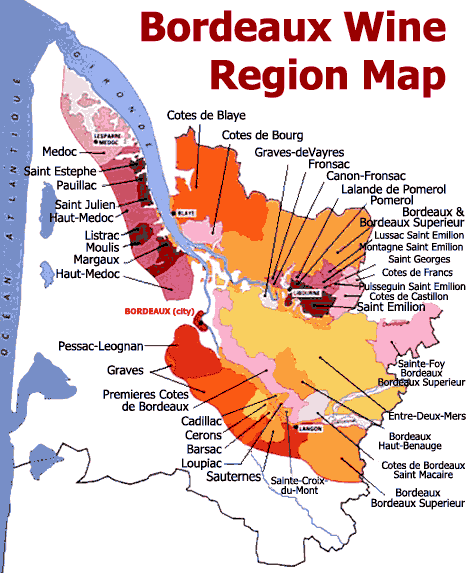
Customers are afraid of the Bordeaux section because first, they figure it will be expensive, and second, they don’t understand what they are reading on the label. Have no fear. Simply put, a red Bordeaux wine is a wine produced in the Bordeaux region of France. It is the largest French wine producing area, composed of over 120,000 hectares of vineyards and producing over 700 million bottles of wine each year.

The region’s hub is the city of Bordeaux, which sits on the west bank of the Gironde River and runs from southeast to northwest on its course to the Atlantic Ocean in west central France. Just north of Bordeaux, the Dordogne River empties into the Gironde from the southeast, forming a “Y”. The Estates along the western bank of the Gironde are known as “Left Bank” and those along the east bank of the Dordogne are known as “Right Bank.” The area between the two arms of the “Y” is known as “Entre Deux Mers” (“between two seas.”)

Why do we care about all this? Here's why:

By law, only six grapes that can be included in red wines from Bordeaux—Cabernet Sauvignon, Merlot, Cabernet Franc, Malbec, Petit Verdot, and Carmenere. The first two are by far the largest contributors. The climate and the soils are vastly different on the Left and Right Banks—so much so that Cabernet Sauvignon grows far better on the Left Bank, and Merlot and Cabernet Franc far better on the Right Bank and in Entre Deux Mers. Consequently, Left Bank wines are Cabernet predominant and therefore more tannic, structured, and long lived as a rule (and less approachable at an early age.) The wines from the Right Bank are Merlot driven, with Cabernet Franc as an important component and much less Cabernet Sauvignon. Right Bank Bordeaux tends to have lusher fruit, somewhat softer tannins, and can be enjoyed at an earlier age. So when you come to the store, you’ll know which “Bank” of Bordeaux you prefer.

If only the label on the wine said “Left” or “Right” Bank, the world would be perfect, but that would be too easy. Instead, the label will usually indicate the appellation, and you should leave it up to your wine geek to know that Medoc, Haut Medoc, Margaux, St. Estephe, Graves, and St. Julian are all Left Bank, and Pomerol, St Emillion, and Canon-Fronsac are Right Bank. As long as you know what style you like, you will get a wine you love.

In 1855, Napolean III requested that Bordeaux wines be classified into five levels, or growths, according to the amount of money they commanded. Four first growths were named—Lafite Rothschild, Margaux, Haut Brion, and Latour. In 1973, Mouton Rothschild was added. All five of these wines are from the Left Bank and cost upwards of $1000.00 per bottle upon release. Even fifth growths which fifteen years ago could be purchased for $30.00-$45.00 now cost over $100.00. Although the Right Bank wines aren’t in this classification, Chateau Cheval Blanc, Chateau Petrus, and Chateau le Pin are still in these price ranges.

Because of these crazy prices, most of us will never get a chance to try these wines, which fuels the idea that Bordeaux is only for the rich. This is not true. Although the first through fifth growths are the most famous fifty or so wines from the Left Bank, and about twenty similar wines exist from the other side, over 8400 other Bordeaux producers remain. These “petits chateaux” produce very nice wines for $40.00, $25.00, and even $15.00. These wines express the terroir and varietal character of the appellation where they are grown and are pleasant to drink often upon the day of bottling. They don’t age like the classified growths but will improve over three or four years.

Bordeaux wines as a rule are made from rather tannic grapes and they are aged in oak, so they’re going to be tannic. Don’t look to these wines for sipping at a cocktail party or drinking on their own by the fire one evening. These are food wines. They have aromatics and flavors of red and black fruit, with solid structure and good acidity. They tend to be a bit lower in alcohol than their California counterparts. These characteristics are typical of the cooler climate in Bordeaux. Because the climate is cool, year to year variance can be marked. Time of last frost, daily temperatures, and amount and time of rainfall all have a huge influence on the quality of wine in a given year. Be sure to ask your wine specialist which vintages to avoid or look for, or which are best for drinking early or putting away for a few years.

So tonight you are having a dinner of beef, lamb, or game. Bordeaux is an excellent choice. If you want to splurge a bit and like the structure of Cab based wines, the Chateau Mongravey (Margaux) is outstanding for $44.99. The Right Bank and Merlot predominant L’Excellence des Menuts at $42.99 is drinking perfectly.

Want to spend less and still drink well? From the Left Bank we have the Chateau Le Pey (Medoc, $16.49) and Chateau Beauregard Lagupeau (Graves, $16.99), and from the Right we have La Croix Bonnelle (St. Emillion, $16.99) and La Croix Meunier (St. Emillion, $24.99). These are all nice examples of Bordeaux at reasonable prices. There are others in the $10.00-12.00 range that will amaze you.

Bordeaux doesn’t have to be complicated and it certainly doesn’t have to be expensive. Wines from this area have been among the most renowned in the world for hundreds of years. It’s time you found out what all the fuss is about. You will be glad you did.

You can “bank” on it!