Tuesday, October 30, 2012

Two Hours in Italy

There is something special about Italian wine. The way it is interwoven into the lifestyle of Italy’s countryside…and the way the lifestyle is woven into it makes it, to me, the most incredible wine experience that exists. When I go to a French tasting, I leave wanting to understand more about French wines. I feel the same about Spain. When I leave an Italian tasting I want to learn Italian. I want to jump on the nearest plane and get lost in the small towns of Tuscany or Piedmont, walking the streets and vineyards.

I had the privilege of eating lunch with Domenico Clerico this week at Mateo, a great Boulder restaurant. Mr. Clerico is getting on in years, has major health issues, and speaks no English. Telling stories through an interpreter, this incredibly respected winemaker came across as a humble farmer who loves what he does, and loves even more sharing his love for it. He seems genuinely amazed that the entire world is clamoring for his wines.

We started with his 2011 Dolcetto Visadi. It was spicy, fruity and all in all a perfect example of this varietal which is the everyday wine in the Piedmont. Next we tried his 2011 Capisme E. This is a stainless steel fermented Nebbiolo. Nebbiolo is Italy’s noble grape that spawns the great Barolos. This is a bright, fruit-forward version of this wonderful grape with vibrant red fruit flavors. Both of these wines went beautifully with cheese, cured meats, paté, and steamed mussels.

Next we tasted his 2010 Arte, a blend of Nebbiolo and Barbera, aged fifteen months in new oak. This is a tannic wine, with toast and vanilla and ample, complex fruit. It went well with the butternut squash risotto with chèvre, walnuts, and roasted mushrooms.

Finally came his two Barolos, the 2008 Pajana and 2008 Ciabot Mentin. These are sourced from opposite ends of the same vineyard, the famed Ginestra. The Pajana is from a south-facing area and is slightly more open and forward than the tightly wound Ciabot, from a south-southeast facing region of the hill. Both are massive wines and will age for many years and become even more magnificent. Although very young, they are brilliant even now, and matched beautifully with the wild boar ragu taglierini and braised beef short ribs with root vegetables.

Clerico’s wines are a luxury—each of his Barolos will set you back a hundred bucks, and the Capisme, $35.00. The Arte is about $45.00 and even the Dolcetto comes in at $24.00. But they are all worth every penny.

Treat yourself to a bottle and enjoy La Bella Vitta!

Sunday, October 14, 2012

Grower Champagnes – A New Approach to “Bubbly”


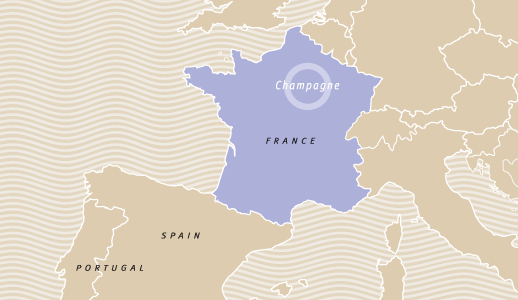
As the holidays approach, sparkling wines come to mind, from inexpensive Proseccos from Italy and Cavas from Spain, to the myriad California and French bubbly to the most famous (and expensive) of all—Champagne (sparkling wine from the Champagne region of  France). Nothing seems to epitomize celebration like Champagne, and when most people consider buying it they look for the large houses such as Moet et Chandon or Veuve Cliquot. These producers source their grapes from all over the region and blend various lots from different areas and even different years to maintain a consistent flavor and style year after year.

There is, however, an interesting alternative—the grower champagnes. The  vineyards sourced by  this type of maker are clustered in a single village and sometimes even a single vineyard. The wines are crafted to reflect the terroir of the village, especially if it is a grand cru vineyard.

Grower Champagnes are usually released younger and often show a lower dosage (the process of adding sugar before final corking) and occasionally no dosage at all. Before shipping, most producers disgorge the deposits that collect in the bottles. The resulting space is filled with a shipping liquor and a tiny bit of pure cane sugar. The absence of dosage allows the intrinsic qualities of the wine, such as terroir and minerality, to show through.

The downside is these wines are more variable year to year compared to the large houses. But the wines are far more interesting and flavorful. Today there are 19,000 growers in Champagne and about 5000 are making their own wines as the popularity grows. To find out if a Champagne is a grower Champagne look for the initials RM (recoltant-manipulant) or ask your wine associate.

While the number of wines is staggering, here are few examples that you can’t go wrong with. Champagne Moutard  is one of my favorite Champagnes period. It is from a grand cuvee vineyard and is 100% Pinot Noir. The wine bursts with brioche, pear, and peach aromas and flavors with beautiful notes of honey, flowers and minerals. The price is about $43.00—not cheap, but on par with Veuve or Moet Chandon NVs, and far more interesting.

Champagne Aubrey is made from a majority of Pinot Meunier with Pinot Noir and Chardonnay as part of the mix. All the fruit is from Grand Cru vineyards. Fresh apples leap from the glass to your nose, with hints of cocoa and toast. There are flavors of passion fruit, apricots and spices, even mango. This wine undergoes malolactic fermentation, giving it impressive body. A beautiful Champagne for $45.00.

Finally there is Jacques Copinet, a NV Champagne that  mimics an aged Vintage Champagne. The aroma is of buttered toast sprinkled with a bit of molasses. On the palate there is a wonderful balance of power, intense caramel breadiness, and wonderful elegance.  Worth the $50.00 you’ll have to spend.

When it’s time to celebrate, try one of these Champagnes and have a truly wonderful experience.

Sunday, September 30, 2012

Forgotten French Grapes – Moved on to “Better” Places?


When customers ask me where the Malbecs are,  I always respond with another question— Argentinian or French?  They look at me quizzically, as though I have no idea what I’m talking about.  I could respond the same way if they asked about Tannat, but no one ever inquires about that wonderful grape.
Many grapes originate in one country but later are found to grow wonderfully in another country and often result in wines completely different from the originals. These wines are fun to compare in “terroir tastings.”

Malbec is an excellent example. This grape originated in Cahors, France and is grown throughout Bordeaux. It’s one of the five grapes that can be blended into the great wines from that region. Wines from Cahors consist mostly of Malbec with a small contribution from another varietal, usually Merlot. These wines are complex, structured with layers of fruit and moderate to fairly big tannins.  Nice examples are Chateau Saint Sernin, Clos La Coutale and Domaine de Cause, all under $20.00. Malbec was later brought to Argentina where it produces massively fruit forward, low tannin wines of medium complexity that are easy drinking, user friendly, and inexpensive. Good examples to try are Durigutti, Renacer Punto Final and  Catena.

Carmenere originated in France and is known as the “forgotten Bordeaux varietal.” It is the sixth grape that is allowed to be blended into Bordeaux, although it has nearly disappeared from that region due to difficulty with ripening. It was brought to Chile, where it prospers. It results in wines with a nose of leather, spice, and chocolate and deep black and blue fruit flavors mixed with spice and pepper. Very nice examples are Odfjell Orzada and Apaltagua.

When the book The Red Wine Diet, which discussed the benefits of red wine on heart health, was published, the author spoke of Tannat, the major grape found in Madiran wines from Southwestern France. Madirans tend to be quite tannic, rustic, and complex. The fiercely tannic Tannat grape is usually blended with Cabernet Sauvignon and/or Cabernet Franc resulting in much softer wines. A great example is 1907, an incredibly complex wine for only $13.00. This grape was brought to South America by Basque immigrants where it has flourished. In fact, it is now the national grape of Uruguay. It also grows well in Argentina. The resulting wine is much more fruit forward and less tannic than Madiran, with lots of dark fruit flavor. A nice is example is made by Rodolfo.

Lots of other grapes move to other places and do well. Grenache originated in Spain and now flourishes in southern France and in Australia, Syrah is everywhere. Zinfandel, known as “America’s grape,” actually originated in Croatia, traveling to America where it is known as Zinfandel, and to Italy where it is known as Primitivo.

So try the same varietal from various parts of the globe. You’ll find out what a difference soil, climate, altitude, and differing winemaking techniques make.  And you’ll no doubt uncover some new favorites!


Wednesday, September 12, 2012

Gruner Veltliner, the Ultimate Food Wine


Our store is located in Boulder, Colorado, a notoriously “foodie” town. We have a huge wine selection and a well-trained wine staff, so we’re often asked about food pairings. Easy, right? Usually, but some foods are difficult.  Asparagus and artichokes, for example, contain a chemical called cynarin which makes wine taste metallic.

Without hesitation, I take customers asking about these two veggies to the Austrian wine section and suggest a Gruner Veltliner (pronounced groon-er velt-leen-er). More often than not, they’ve never heard of it, but if they take my suggestion, it soon becomes one of their “go to” wines.

Gruner Veltliner is grown primarily in Austria where it comprises about 37% of the total grape production. There are two basic expressions of this varietal. If it is grown in the granite soils on the very steep hillsides along the Danube west of Vienna in the areas of Wachau, Kamptal, and Kremstal, the wine is very pure with perfect acidity and enormous minerality—sometimes described as “liquid stone.” These wines are full bodied with beautiful perfumed aromatics and age gracefully. They have the strength of character to match with any food. If the grapes are grown in the southern plains, the perfume is peppery and spicy, and these wines are drunk young.

Berger from Kremstal is crown capped like a beer bottle and comes as a liter only. The wine is light, faintly herbal, and is refreshing like minerally cold spring water. This an excellent entry level Gruner at $15. You’ll be glad it comes as a liter since one glass will not be enough.

Nigl Kremser Freiheit, also from Kremstal, has a smoky, creamy nose that is gradually overtaken by bright fruit and minerals. Light and stimulating, firm and lively, this is a wonderful wine for chicken and artichokes, asparagus soup, or just about any other food.

Arndorfer Weinberge, from Kamptal, is a spicy Gruner with vibrant minerality and acidity, and notes of grass and citrus on the nose. This is a perfect wine to start the evening, as the acidity makes the mouth water and the mind crave food. A great example of this grape’s potential, it’s a bargain for $25.00. Martin Arndorfer, not yet thirty years old, and his wife both come from familes of great winemakers. I had the privilege of meeting this enthusiastic yet humble young man and tasting through a half dozen of his wines, including his Vorgeschmack, 80% Gruner and 20% dry Riesling, aged four months on the lees in 80% stainless steel and 20% used oak. This wine has been one of my staff picks ever since.

Gruner Veltliner is one of the greatest food wines available. The freshness and vibrancy make it especially well suited for cooking that focuses on fresh local ingredients. Chefs all over the world are embracing it.

So next time you head to your wine shop, think Austria!

Monday, August 6, 2012

FUN WITH THE BLENDER
GREAT RED WINES


Many people who come in the store look for specific varietals of wine…Cabernet, Chardonnay, etc. However, many wines are blends of two or more different grapes. The different grapes contribute different aspects to the flavor profile of the wine. One grape may add structure, another may supply dark fruits, and another may add spice. As a result, the wines can be remarkably complex and flavorful.

Many countries in Europe label their wines by the region where they are grown (Bordeaux, Chateauneuf du Pape) rather than the type of grape in the bottle, and these are very often blends of several grapes.

Bordeaux wines can contain up to five specific grapes—Cabernet Franc, Cabernet Sauvignon, Merlot, Petit Verdot and Malbec. (Carmenere is also allowed, but almost never used). These wines tend to be dry, structured, and complex. Although some can cost over $1000.00 a bottle, many wonderful examples exist in the $10.00 to $20.00 range. Look for Chateau Vrai Caillou, Terrefort Lescalle and St. Elme.

Meritage (rhymes with “heritage”) is an American wine that contains a combination of the same grapes found in Bordeaux wines. Claret is yet another term for the same type of wine. Newton, Rodney Strong, and Franciscan are a few to look for. Lyeth makes a nice one for under $15.00.

Up to nine different grapes an be used in Chateauneuf du Pape, though Grenache, Syrah, and Mouvedre are the most common. These are complex age-worthy wines and can be very expensive. If you have $80.00 or $90.00 to spend, look for Mas de Boislauzon Quet or Janasse Chaupin  from the 2010 vintage. These are magnificent wines. For $30.00 you can drink a very nice example from Barrot. Chateauneuf du Pape is in the southern Rhone. Lots of wonderful inexpensive wines from the various villages that comprise the area nestled at the foothills of the mountains are available. They are usually blends of Grenache and Syrah with either Mouvedre, Carignan, or Cinsault added to the mix. They are great wines for a great price. Look for Boisson Cairanne, Chateau Pesquie, and Gassier Cercius, all under $20.00 and wonderful.

The blend of Grenache, Syrah, and Mouvedre has made its way from the Rhone Valley to Australia and the U.S. and has become so popular that they are referred to as “GSM” blends. John Duval’s Plexus and Two Hands Brave Faces are beautiful examples from “Down Under,” Stump Jump is a great example at a cheaper price.

In addition to the GSM formula, California produces many blends, combining Syrah, Merlot, Zinfandel, Petit Sirah, Tempranillo, Cinsault, Cabernet Sauvignon, Mourvedre, Grenache, Sangiovese, and Barbera—sometimes up to six or more in one wine. I like to call these “kitchen sink “ wines. Great examples are Orin Swift’s Prisoner at $40.00 and a much cheaper wine called The Culprit 2010 at $15.00.

Blended wines offer wonderful complexity and big flavors, often for great prices. Give them a try!

Saturday, July 21, 2012

Moscato d’Asti—Summer’s Perfect Wine


Moscato d’Asti is produced mostly around the town of Asti in Southeast Piedmont, probably Italy’s most important wine producing region. It is made in a frizzante (lightly sparkling) style, is low in alcohol (4.5 - 6.5%) and has a zippy acidity that makes it an ideal summer refresher. Despite being modestly sweet, the low alcohol and good acidity clear the palate, so it's not syrupy or cloying. This makes the second glass as good as the first. It is made from the Muscato Bianco grape, which has been grown in Piedmont for hundreds of years.  Although made in the same area and from the same grape, it is distinct from Asti Spumante, a fully sparkling wine typically done in a drier style.

Moscato d’Asti is known for its freshness, elegant floral aromas, and delicate flavors of peaches and apricots. The wine is typically paired with non-chocolate desserts, particularly the classic Panatonne (a sweet bread containing candied orange, citron, and lemon zest), fruit tarts, or dry pastries made with hazelnuts or almonds. It’s also a great apéritif.

Many wineries produce this wine, including some of the most well known estates in Piedmont. It is not particularly expensive, usually in the $12.00  to $20.00 range.

Vietti Cascinetta is made from only the best grapes harvested from thirty-five year old vines. The nose suggests aromas of peaches, rose petals, and ginger. On the palate, its modest sweetness is perfectly balanced with acidity and minerality. Fresh apricots round out the creamy finish. Price tag? About $16.00.

A bit pricier at $15.00 per half bottle, but probably one of Piedmont’s best Muscatos, is Michele Chiarlo Nivole. Nivole means “clouds” in the Piedmontese dialect, and it appropriately suggests the wine’s airy, elegant quality. The fragrant, intensely fruity bouquet is offset by musky notes and leads to flavors of fresh peaches, apricots, and a hint of lemon.  Its refined sweetness is supported by an excellent balance of acid and bubbles. The finish is clear and crisp. You’ll wish it came in full bottles. The half is simply not enough of this beauty.

I drink dry wines ninety-five percent of the time. When I’m in the mood for something a little sweeter, Moscato d’Asti is the one I choose (except for the occassional Riesling or Port, of course.) Give it a try. You’ll love it.

Monday, July 9, 2012

It’s Greek To Me


When considering Greek wines, many think of Retsina as the country’s only contribution. This bizarre wine, flavored with the resin of the Aleppo Pine, has a taste reminiscent of disinfectant and turpentine and is drunk in wide-mouthed tumblers to prevent the aroma and flavor from overwhelming the drinker.

This is NOT the final word on Greek wines.

In fact, Greece produces many beautiful wines both on the mainland and on the islands. These wines are made from unfamiliar-sounding grapes that result in fresh, aromatic whites and bold, flavorful reds.

One very reliable producer is Domaine Skouras from the northern part of the Greek mainland. They make several wines, but the first I ever tried remains one of my favorites—the Skouras White. This is a blend of Roditis and Moscofilero. It is aged over lees in stainless steel resulting in a light to medium bodied wine with husky, citrus, floral, and herbal aromas.  Flavors of tangerine, lemon, and melon combine with a fresh, crisp acidity and a minerally finish – all for about ten bucks.

The Skouras St. George Nemea 2008 is made from 100% Aghiorghitiko. The nose is of berries – blackberries, raspberries and even strawberries. On the palate, the fruit turns more towards blue – blueberries and plums with a bit of vanilla. The wine is medium bodied, earthy, with ripe tannins and a nice acidity.  This is a fun wine for $14.00.

Alpha Estate’s Axia 2008 is a blend of 50% Syrah and 50% Xinomavro, and it is a mouthful of wine! A complex bouquet of spices (vanilla, clove and pepper) and violets with hints of blackberry hits the nose. Wonderful berry fruit (blue and black), earth, and spice strike the palate. The tannins are velvety and the acidity is just right. This is a great wine on its own and also with food.

Not to be outdone by the mainland, the island of Crete is responsible for 20% of Greece’s wine production. The Alexakis family is a cooperative that makes great wines. The 2011 Malvasia Aromatica, related to the Malvasia of Italy, is well named. This wine is intensely aromatic with sweet notes of honeysuckle, orange, and jasmine. The nose suggests a sweet palate to follow. However, it is fresh, crisp, and citrusy  with a beautiful acidity.  This is a great food wine, and the contrast between the sweet aromatics and the dry, refreshing palate makes it a fascinating sipping wine.

The  2008 red wine from this co-op is a blend of 40% Syrah and 60% Kotsifali. The latter is the most traditional red varietal on Crete. This wine has aromatics of cinnamon, clove, and blackberry. The medium bodied wine has a background of berry fruit with lots of spice (cinnamon, pepper) and earth (dirt, actually).  I am pleasantly reminded of a forest floor. This is a very interesting wine that I’m going to have with my next lamb dinner.

Next time you are thinking of a white, instead of Chardonnay think Malvasia Aromatica! Instead of Zinfandel, think Xinomavro!  But by all means think about giving Greece a chance to impress you. You won’t be disappointed.